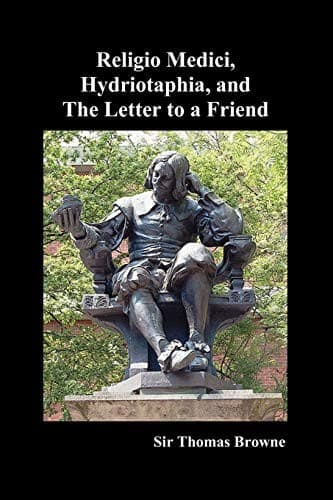
Religio Medici, Hydriotaphia, and the Letter to a FriendBrowne, Thomas, Sir
Religion
Religio Medici, Hydriotaphia, and the Letter to a Friend
Browne, Thomas, Sir
Christian ethics; Christian life; Essays; Funeral rites and ceremonies; Medical ethics; Medicine -- History; Religion and medicine
Civilians make sepulture but of the law of nations, others do
naturally found it and discover it also in animals. They that are so
thick-skinned as still to credit the story of the Phœnix, may say
something for animal burning. More serious conjectures find some
examples of sepulture in elephants, cranes, the sepulchral cells of
pismires, and practice of bees,--which civil society carrieth out their
dead, and hath exequies, if not interments.
CHAPTER II.
THE solemnities, ceremonies, rites of their cremation or interment,
so solemnly delivered by authors, we shall not disparage our reader
to repeat. Only the last and lasting part in their urns, collected
bones and ashes, we cannot wholly omit or decline that subject, which
occasion lately presented, in some discovered among us.
In a field of Old Walsingham, not many months past, were digged up
between forty and fifty urns, deposited in a dry and sandy soil, not a
yard deep, nor far from one another.--Not all strictly of one figure,
but most answering these described; some containing two pounds of
bones, and teeth, with fresh impressions of their combustion; besides
the extraneous substances, like pieces of small boxes, or combs
handsomely wrought, handles of small brass instruments, brazen nippers,
and in one some kind of opal.
Near the same plot of ground, for about six yards compass, were digged
up coals and incinerated substances, which begat conjecture that this
was the _ustrina_ or place of burning their bodies, or some sacrificing
place unto the _Manes_, which was properly below the surface of the
ground, as the _aræ_ and altars unto the gods and heroes above it.
That these were the urns of Romans from the common custom and place
where they were found, is no obscure conjecture, not far from a Roman
garrison, and but five miles from Brancaster, set down by ancient
record under the name of Branodunum. And where the adjoining town,
containing seven parishes, in no very different sound, but Saxon
termination, still retains the name of Burnham, which being an early
station, it is not improbable the neighbour parts were filled with
habitations, either of Romans themselves, or Britons Romanized, which
observed the Roman customs.
Public-domain text, read in full here on John Shaqi.
Reviews
Reviews
No reviews yet
Be the first to share your thoughts on this work.
Elsewhere in the archive
Join the Discussion
Join the discussion
Sign in to leave a comment or review.
Sign InorCreate an account