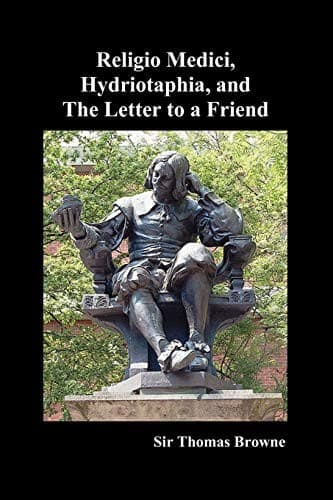
Religio Medici, Hydriotaphia, and the Letter to a FriendBrowne, Thomas, Sir
Religion
Religio Medici, Hydriotaphia, and the Letter to a Friend
Browne, Thomas, Sir
Christian ethics; Christian life; Essays; Funeral rites and ceremonies; Medical ethics; Medicine -- History; Religion and medicine
Nor is it improbable, that the Romans early possessed this country.
For though we meet not with such strict particulars of these parts
before the new institution of Constantine and military charge of the
count of the Saxon shore, and that about the Saxon invasions, the
Dalmatian horsemen were in the garrison of Brancaster; yet in the time
of Claudius, Vespasian, and Severus, we find no less than three legions
dispersed through the province of Britain. And as high as the reign
of Claudius a great overthrow was given unto the Iceni, by the Roman
lieutenant Ostorius. Not long after, the country was so molested, that,
in hope of a better state, Prastaagus bequeathed his kingdom unto Nero
and his daughters; and Boadicea, his queen, fought the last decisive
battle with Paulinus. After which time, and conquest of Agricola, the
lieutenant of Vespasian, probable it is, they wholly possessed this
country; ordering it into garrisons or habitations best suitable with
their securities. And so some Roman habitations not improbable in these
parts, as high as the time of Vespasian, where the Saxons after seated,
in whose thin-filled maps we yet find the name of Walsingham. Now if
the Iceni were but Gammadims, Anconians, or men that lived in an angle,
wedge, or elbow of Britain, according to the original etymology, this
country will challenge the emphatical appellation, as most properly
making the elbow or _iken_ of Icenia.
That Britain was notably populous is undeniable, from that expression
of Cæsar.[AM] That the Romans themselves were early in no small
numbers--seventy thousand, with their associates, slain, by Boadicea,
affords a sure account. And though not many Roman habitations are now
known, yet some, by old works, rampiers, coins, and urns, do testify
their possessions. Some urns have been found at Castor, some also
about Southcreak, and, not many years past, no less than ten in a
field at Buxton, not near any recorded garrison. Nor is it strange to
find Roman coins of copper and silver among us; of Vespasian, Trajan,
Adrian, Commodus, Antoninus, Severus, &c.; but the greater number of
Dioclesian, Constantine, Constans, Valens, with many of Victorinus
Posthumius, Tetricus, and the thirty tyrants in the reign of Gallienus;
and some as high as Adrianus have been found about Thetford, or
Sitomagus, mentioned in the _Itinerary_ of Antoninus, as the way from
Venta or Castor unto London. But the most frequent discovery is made at
the two Castors by Norwich and Yarmouth at Burghcastle, and Brancaster.
[AM] “Hominum infinita multitudo est creberrimaque; ædificia fere
Gallicis consimilia.”--_Cæsar de Bello. Gal._, lib. v.
Public-domain text, read in full here on John Shaqi.
Reviews
Reviews
No reviews yet
Be the first to share your thoughts on this work.
Elsewhere in the archive
Join the Discussion
Join the discussion
Sign in to leave a comment or review.
Sign InorCreate an account