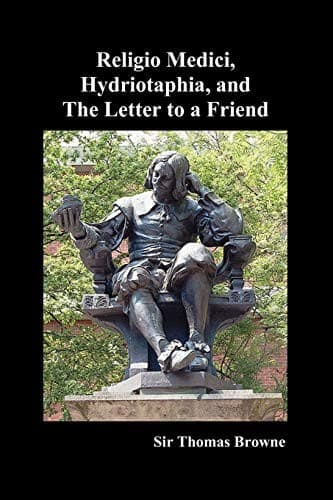
Religio Medici, Hydriotaphia, and the Letter to a FriendBrowne, Thomas, Sir
Religion
Religio Medici, Hydriotaphia, and the Letter to a Friend
Browne, Thomas, Sir
Christian ethics; Christian life; Essays; Funeral rites and ceremonies; Medical ethics; Medicine -- History; Religion and medicine
Besides the Norman, Saxon, and Danish pieces of Cuthred, Canutus,
William, Matilda, and others, some British coins of gold have been
dispersedly found, and no small number of silver pieces near Norwich,
with a rude head upon the obverse, and an ill-formed horse on the
reverse, with inscriptions _Ic. Duro. T.;_ whether implying Iceni,
Durotriges, Tascia, or Trinobantes, we leave to higher conjecture.
Vulgar chronology will have Norwich Castle as old as Julius Cæsar;
but his distance from these parts, and its Gothick form of structure,
abridgeth such antiquity. The British coins afford conjecture of early
habitation in these parts, though the city of Norwich arose from the
ruins of Venta; and though, perhaps, not without some habitation
before, was enlarged, builded, and nominated by the Saxons. In what
bulk or populosity it stood in the old East-Angle monarchy tradition
and history are silent. Considerable it was in the Danish eruptions,
when Sueno burnt Thetford and Norwich, and Ulfketel, the governor
thereof, was able to make some resistance, and after endeavoured to
burn the Danish navy.
How the Romans left so many coins in countries of their conquests
seems of hard resolution; except we consider how they buried them
under ground when, upon barbarous invasions, they were fain to desert
their habitations in most part of their empire, and the strictness
of their laws forbidding to transfer them to any other uses: wherein
the Spartans were singular, who, to make their copper money useless,
contempered it with vinegar. That the Britons left any, some wonder,
since their money was iron and iron rings before Cæsar; and those of
after-stamp by permission, and but small in bulk and bigness. That so
few of the Saxons remain, because, overcome by succeeding conquerors
upon the place, their coins, by degrees, passed into other stamps and
the marks of after-ages.
Than the time of these urns deposited, or precise antiquity of these
relicks, nothing of more uncertainty; for since the lieutenant of
Claudius seems to have made the first progress into these parts, since
Boadicea was overthrown by the forces of Nero, and Agricola put a
full end to these conquests, it is not probable the country was fully
garrisoned or planted before; and, therefore, however these urns might
be of later date, not likely of higher antiquity.
And the succeeding emperors desisted not from their conquests in these
and other parts, as testified by history and medal-inscription yet
extant: the province of Britain, in so divided a distance from Rome,
beholding the faces of many imperial persons, and in large account;
no fewer than Cæsar, Claudius, Britannicus, Vespasian, Titus, Adrian,
Severus, Commodus, Geta, and Caracalla.
Public-domain text, read in full here on John Shaqi.
Reviews
Reviews
No reviews yet
Be the first to share your thoughts on this work.
Elsewhere in the archive
Join the Discussion
Join the discussion
Sign in to leave a comment or review.
Sign InorCreate an account