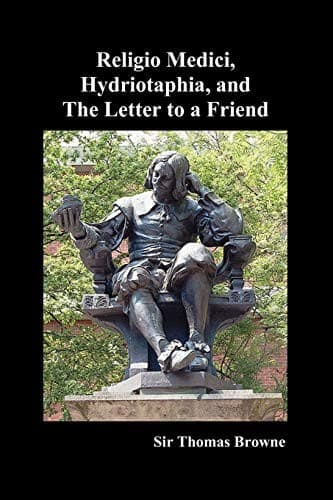
Religio Medici, Hydriotaphia, and the Letter to a FriendBrowne, Thomas, Sir
Religion
Religio Medici, Hydriotaphia, and the Letter to a Friend
Browne, Thomas, Sir
Christian ethics; Christian life; Essays; Funeral rites and ceremonies; Medical ethics; Medicine -- History; Religion and medicine
A great obscurity herein, because no medal or emperor’s coin enclosed,
which might denote the date of their interments; observable in many
urns, and found in those of Spitalfields, by London, which contained
the coins of Claudius, Vespasian, Commodus, Antoninus, attended with
lacrymatories, lamps, bottles of liquor, and other appurtenances of
affectionate superstition, which in these rural interments were wanting.
Some uncertainty there is from the period or term of burning, or the
cessation of that practice. Macrobius affirmeth it was disused in his
days; but most agree, though without authentic record, that it ceased
with the Antonini,--most safely to be understood after the reign of
those emperors which assumed the name of Antoninus, extending unto
Heliogabalus. Not strictly after Marcus; for about fifty years later,
we find the magnificent burning and consecration of Servus; and, if
we so fix this period or cessation, these urns will challenge above
thirteen hundred years.
But whether this practice was only then left by emperors and great
persons, or generally about Rome, and not in other provinces, we hold
no authentic account; for after Tertullian, in the days of Minucius,
it was obviously objected upon Christians, that they condemned the
practice of burning.[AN] And we find a passage in Sidonius, which
asserteth that practice in France unto a lower account. And, perhaps,
not fully disused till Christianity fully established, which gave the
final extinction to these sepulchral bonfires.
[AN] “_Execrantur rogos, et damnant ignium sepulturam._”--_Min. in Oct._
Whether they were the bones of men, or women, or children, no authentic
decision from ancient custom in distinct places of burial. Although not
improbably conjectured, that the double sepulture, or burying-place of
Abraham, had in it such intention. But from exility of bones, thinness
of skulls, smallness of teeth, ribs, and thigh-bones, not improbable
that many thereof were persons of minor age, or woman. Confirmable also
from things contained in them. In most were found substances resembling
combs, plates like boxes, fastened with iron pins, and handsomely
overwrought like the necks or bridges of musical instruments; long
brass plates overwrought like the handles of neat implements; brazen
nippers, to pull away hair; and in one a kind of opal, yet maintaining
a bluish colour.
Public-domain text, read in full here on John Shaqi.
Reviews
Reviews
No reviews yet
Be the first to share your thoughts on this work.
Elsewhere in the archive
Join the Discussion
Join the discussion
Sign in to leave a comment or review.
Sign InorCreate an account