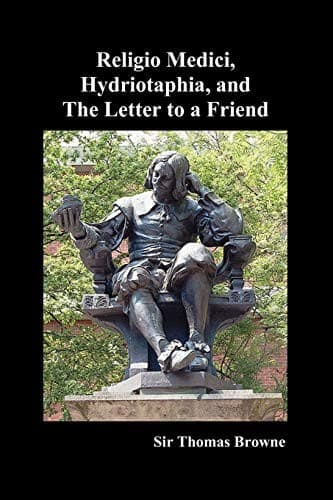
Religio Medici, Hydriotaphia, and the Letter to a FriendBrowne, Thomas, Sir
Religion
Religio Medici, Hydriotaphia, and the Letter to a Friend
Browne, Thomas, Sir
Christian ethics; Christian life; Essays; Funeral rites and ceremonies; Medical ethics; Medicine -- History; Religion and medicine
Now that they accustomed to burn or bury with them, things wherein
they excelled, delighted, or which were dear unto them, either as
farewells unto all pleasure, or vain apprehension that they might use
them in the other world, is testified by all antiquity, observable
from the gem or beryl ring upon the finger of Cynthia, the mistress of
Propertius, when after her funeral pyre her ghost appeared unto him;
and notably illustrated from the contents of that Roman urn preserved
by Cardinal Farnese, wherein besides great number of gems with heads
of gods and goddesses, were found an ape of agath, a grasshopper, an
elephant of amber, a crystal ball, three glasses, two spoons, and
six nuts of crystal; and beyond the content of urns, in the monument
of Childerick the first, and fourth king from Pharamond, casually
discovered three years past at Tournay, restoring unto the world much
gold richly adorning his sword, two hundred rubies, many hundred
imperial coins, three hundred golden bees, the bones and horse-shoes of
his horse interred with him, according to the barbarous magnificence
of those days in their sepulchral obsequies. Although, if we steer by
the conjecture of many a Septuagint expression, some trace thereof may
be found even with the ancient Hebrews, not only from the sepulchral
treasure of David, but the circumcision knives which Joshua also buried.
Some men, considering the contents of these urns, lasting pieces and
toys included in them, and the custom of burning with many other
nations, might somewhat doubt whether all urns found among us, were
properly Roman relicks, or some not belonging unto our British, Saxon,
or Danish forefathers.
In the form of burial among the ancient Britons, the large discourses
of Cæsar, Tacitus, and Strabo are silent. For the discovery whereof,
with other particulars, we much deplore the loss of that letter which
Cicero expected or received from his brother Quintus, as a resolution
of British customs; or the account which might have been made by
Scribonius Largus, the physician, accompanying the Emperor Claudius,
who might have also discovered that frugal bit of the old Britons,
which in the bigness of a bean could satisfy their thirst and hunger.
Public-domain text, read in full here on John Shaqi.
Reviews
Reviews
No reviews yet
Be the first to share your thoughts on this work.
Elsewhere in the archive
Join the Discussion
Join the discussion
Sign in to leave a comment or review.
Sign InorCreate an account