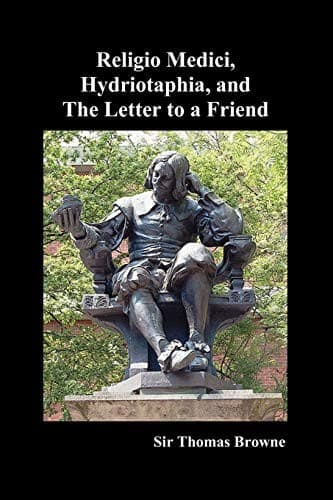
Religio Medici, Hydriotaphia, and the Letter to a FriendBrowne, Thomas, Sir
Religion
Religio Medici, Hydriotaphia, and the Letter to a Friend
Browne, Thomas, Sir
Christian ethics; Christian life; Essays; Funeral rites and ceremonies; Medical ethics; Medicine -- History; Religion and medicine
In the monument of King Childerick the iron relicks were found all
rusty and crumbling into pieces; but our little iron pins, which
fastened the ivory works, held well together, and lost not their
magnetical quality, though wanting a tenacious moisture for the firmer
union of parts; although it be hardly drawn into fusion, yet that metal
soon submitteth unto rust and dissolution. In the brazen pieces we
admired not the duration, but the freedom from rust, and ill savour,
upon the hardest attrition; but now exposed unto the piercing atoms
of air, in the space of a few months, they begin to spot and betray
their green entrails. We conceive not these urns to have descended
thus naked as they appear, or to have entered their graves without the
old habit of flowers. The urn of Philopœmen was so laden with flowers
and ribbons, that it afforded no sight of itself. The rigid Lycurgus
allowed olive and myrtle. The Athenians might fairly except against
the practice of Democritus, to be buried up in honey, as fearing to
embezzle a great commodity of their country, and the best of that kind
in Europe. But Plato seemed too frugally politick, who allowed no
larger monument than would contain four heroick verses, and designed
the most barren ground for sepulture: though we cannot commend the
goodness of that sepulchral ground which was set at no higher rate than
the mean salary of Judas. Though the earth had confounded the ashes
of these ossuaries, yet the bones were so smartly burnt, that some
thin plates of brass were found half melted among them. Whereby we
apprehend they were not of the meanest caresses, perfunctorily fired,
as sometimes in military, and commonly in pestilence, burnings; or
after the manner of abject corpses, huddled forth and carelessly burnt,
without the Esquiline Port at Rome; which was an affront continued upon
Tiberius, while they but half burnt his body, and in the amphitheatre,
according to the custom in notable malefactors;[AX] whereas Nero seemed
not so much to fear his death as that his head should be cut off and
his body not burnt entire.
[AX] “In amphitheatro semiustulandum.”--_Suetonius Vit. Tib._
Public-domain text, read in full here on John Shaqi.
Reviews
Reviews
No reviews yet
Be the first to share your thoughts on this work.
Elsewhere in the archive
Join the Discussion
Join the discussion
Sign in to leave a comment or review.
Sign InorCreate an account