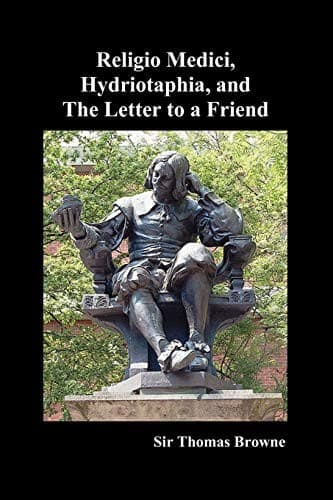
Religio Medici, Hydriotaphia, and the Letter to a FriendBrowne, Thomas, Sir
Religion
Religio Medici, Hydriotaphia, and the Letter to a Friend
Browne, Thomas, Sir
Christian ethics; Christian life; Essays; Funeral rites and ceremonies; Medical ethics; Medicine -- History; Religion and medicine
Some, finding many fragments of skulls in these urns, suspected
a mixture of bones; in none we searched was there cause of such
conjecture, though sometimes they declined not that practice.--The
ashes of Domitian were mingled with those of Julia; of Achilles with
those of Patroclus. All urns contained not single ashes; without
confused burnings they affectionately compounded their bones;
passionately endeavouring to continue their living unions. And when
distance of death denied such conjunctions, unsatisfied affections
conceived some satisfaction to be neighbours in the grave, to lie urn
by urn, and touch but in their manes. And many were so curious to
continue their living relations, that they contrived large and family
urns, wherein the ashes of their nearest friends and kindred might
successively be received, at least some parcels thereof, while their
collateral memorials lay in minor vessels about them.
Antiquity held too light thoughts from objects of mortality, while
some drew provocatives of mirth from anatomies,[AY] and jugglers
showed tricks with skeletons. When fiddlers made not so pleasant mirth
as fencers, and men could sit with quiet stomachs, while hanging
was played before them.[AZ] Old considerations made few mementos
by skulls and bones upon their monuments. In the Egyptian obelisks
and hieroglyphical figures it is not easy to meet with bones. The
sepulchral lamps speak nothing less than sepulture, and in their
literal draughts prove often obscene and antick pieces. Where we
find _D. M._[BA] it is obvious to meet with sacrificing _pateras_
and vessels of libation upon old sepulchral monuments. In the Jewish
hypogæum and subterranean cell at Rome, was little observable beside
the variety of lamps and frequent draughts of Anthony and Jerome we
meet with thigh-bones and death’s-heads; but the cemeterial cells of
ancient Christians and martyrs were filled with draughts of Scripture
stories; not declining the flourishes of cypress, palms, and olive,
and the mystical figures of peacocks, doves, and cocks; but iterately
affecting the portraits of Enoch, Lazarus, Jonas, and the vision of
Ezekiel, as hopeful draughts, and hinting imagery of the resurrection,
which is the life of the grave, and sweetens our habitations in the
land of moles and pismires.
[AY] “Sic erimus cuncti, ... ergo dum vivimus vivamus.”
[AZ] Αγώνον παίζειν. A barbarous pastime at feasts, when men stood
upon a rolling globe, with their necks in a rope and a knife in their
hands, ready to cut it when the stone was rolled away, wherein, if they
failed, they lost their lives, to the laughter of their spectators.
[BA] Diis manibus.
Public-domain text, read in full here on John Shaqi.
Reviews
Reviews
No reviews yet
Be the first to share your thoughts on this work.
Elsewhere in the archive
Join the Discussion
Join the discussion
Sign in to leave a comment or review.
Sign InorCreate an account