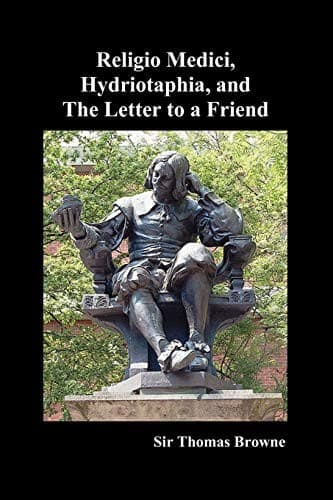
Religio Medici, Hydriotaphia, and the Letter to a FriendBrowne, Thomas, Sir
Religion
Religio Medici, Hydriotaphia, and the Letter to a Friend
Browne, Thomas, Sir
Christian ethics; Christian life; Essays; Funeral rites and ceremonies; Medical ethics; Medicine -- History; Religion and medicine
Gentle inscriptions precisely delivered the extent of men’s lives,
seldom the manner of their deaths, which history itself so often leaves
obscure in the records of memorable persons. There is scarce any
philosopher but dies twice or thrice in Laertius; nor almost any life
without two or three deaths in Plutarch; which makes the tragical ends
of noble persons more favourably resented by compassionate readers who
find some relief in the election of such differences.
The certainty of death is attended with uncertainties, in time, manner,
places. The variety of monuments hath often obscured true graves; and
cenotaphs confounded sepulchres. For beside their real tombs, many have
found honorary and empty sepulchres. The variety of Homer’s monuments
made him of various countries. Euripides had his tomb in Africa, but
his sepulture in Macedonia. And Severus found his real sepulchre in
Rome, but his empty grave in Gallia.
He that lay in a golden urn eminently above the earth, was not like
to find the quiet of his bones. Many of these urns were broke by a
vulgar discoverer in hope of enclosed treasure. The ashes of Marcellus
were lost above ground, upon the like account. Where profit hath
prompted, no age hath wanted such miners. For which the most barbarous
expilators found the most civil rhetorick. Gold once out of the earth
is no more due unto it; what was unreasonably committed to the ground,
is reasonably resumed from it; let monuments and rich fabricks, not
riches, adorn men’s ashes. The commerce of the living is not to be
transferred unto the dead; it is not injustice to take that which none
complains to lose, and no man is wronged where no man is possessor.
What virtue yet sleeps in this _terra damnata_ and aged cinders, were
petty magic to experiment. These crumbling relicks and long fired
particles superannuate such expectations; bones, hairs, nails, and
teeth of the dead, were the treasures of old sorcerers. In vain we
revive such practices; present superstition too visibly perpetuates the
folly of our forefathers, wherein unto old observation this island was
so complete, that it might have instructed Persia.
Public-domain text, read in full here on John Shaqi.
Reviews
Reviews
No reviews yet
Be the first to share your thoughts on this work.
Elsewhere in the archive
Join the Discussion
Join the discussion
Sign in to leave a comment or review.
Sign InorCreate an account