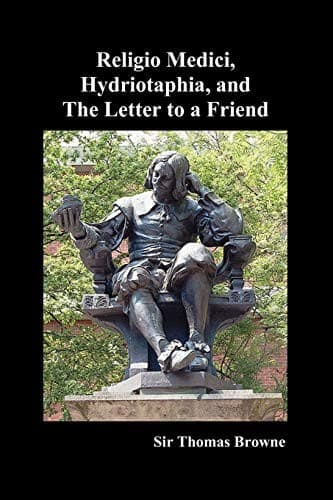
Religio Medici, Hydriotaphia, and the Letter to a FriendBrowne, Thomas, Sir
Religion
Religio Medici, Hydriotaphia, and the Letter to a Friend
Browne, Thomas, Sir
Christian ethics; Christian life; Essays; Funeral rites and ceremonies; Medical ethics; Medicine -- History; Religion and medicine
Plato’s historian of the other world lies twelve days incorrupted,
while his soul was viewing the large stations of the dead. How to
keep the corpse seven days from corruption by anointing and washing,
without extenteration, were an hazardable piece of art, in our choicest
practice. How they made distinct separation of bones and ashes from
fiery admixture, hath found no historical solution; though they seemed
to make a distinct collection and overlooked not Pyrrhus his toe. Some
provision they might make by fictile vessels, coverings, tiles, or flat
stones, upon and about the body (and in the same field, not far from
these urns, many stones were found underground), as also by careful
separation of extraneous matter composing and raking up the burnt bones
with forks, observable in that notable lamp of Galvanus Martianus,
who had the sight of the _vas ustrinum_ or vessel wherein they burnt
the dead, found in the Esquiline field at Rome, might have afforded
clearer solution. But their insatisfaction herein begat that remarkable
invention in the funeral pyres of some princes, by incombustible sheets
made with a texture of asbestos, incremable flax, or salamander’s wool,
which preserved their bones and ashes incommixed.
How the bulk of a man should sink into so few pounds of bones and
ashes, may seem strange unto any who considers not its constitution,
and how slender a mass will remain upon an open and urging fire of the
carnal composition. Even bones themselves, reduced into ashes, do abate
a notable proportion. And consisting much of a volatile salt, when that
is fired out, make a light kind of cinders. Although their bulk be
disproportionable to their weight, when the heavy principle of salt is
fired out, and the earth almost only remaineth; observable in sallow,
which makes more ashes than oak, and discovers the common fraud of
selling ashes by measure, and not by ponderation.
Some bones make best skeletons, some bodies quick and speediest ashes.
Who would expect a quick flame from hydropical Heraclitus? The poisoned
soldier when his belly brake, put out two pyres in Plutarch. But in the
plague of Athens, one private pyre served two or three intruders; and
the Saracens burnt in large heaps, by the king of Castile, showed how
little fuel sufficeth. Though the funeral pyre of Patroclus took up
an hundred foot,[BB] a piece of an old boat burnt Pompey; and if the
burthen of Isaac were sufficient for an holocaust, a man may carry his
own pyre.
[BB] “Ἑκατόμπεδον ἔνθα ἢ ἔνθα.”
Public-domain text, read in full here on John Shaqi.
Reviews
Reviews
No reviews yet
Be the first to share your thoughts on this work.
Elsewhere in the archive
Join the Discussion
Join the discussion
Sign in to leave a comment or review.
Sign InorCreate an account