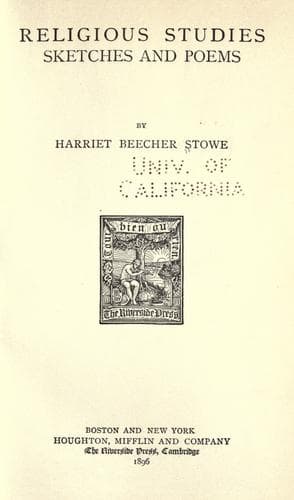
Religious Studies, Sketches and PoemsStowe, Harriet Beecher
Religion
Religious Studies, Sketches and Poems
Stowe, Harriet Beecher
Religion
He then goes through with all the perplexing mysteries of life. He
sees the wicked prosperous and successful, and he that had always
been devoted to God reduced to the extreme of human misery; he
wrestles with the problem; he longs to ask an explanation; but it
all comes to one mournful conclusion:--
"He is not a man as I am, that I should answer him, and we
should come together in judgment. Neither is there any daysman
[arbiter] between us, that might lay his hand on both of us.
Let him take his rod away and let not his fear terrify me. Then
would I speak; but it is not so with me."
Here we have in a word the deepest want of humanity: a daysman
between the infinite God and finite man; a Mediator who should lay
his hand on both of them! And then, in the midst of these yearnings
and complainings, the Spirit of God, the Heavenly Comforter, bearing
witness with Job's spirit, breaks forth in the prophetic song:--
"I know that my Redeemer liveth
And that he shall stand in the latter days upon the earth.
And though worms destroy this body,
Yet in my flesh shall I see God.
I shall see him for myself and not another.
My reins are consumed with longing for that day."
As time passes we have the history of one man, called from all
the races of men to be the ancestor of this SEED. Abraham, called
to leave his native land and go forth sojourning as a pilgrim and
stranger on earth, receives a celestial visitor who says: "Abraham,
I am the Almighty God. Walk before me and be thou perfect." He
exacts of Abraham the extremes of devotion--not only to leave his
country, kindred, friends, and be a sojourner in a strange land, but
to sacrifice the only son of his heart. And Abraham meets the test
without a wavering thought; his trust in God is absolute: and in
return he receives the promise, "In THY SEED shall all the nations
of the earth be blessed." How Abraham looked upon this promise we
are told by our Lord himself. The Jews asked him, "Art thou greater
than our father Abraham?" And he answered, "Your father Abraham
rejoiced to see my day--he saw it, and was glad."
The same promise was repeated to Jacob in the self-same words, when
he lay sleeping in the field of Luz and saw the heavenly vision of
the Son of man.
Public-domain text, read in full here on John Shaqi.
Reviews
Reviews
No reviews yet
Be the first to share your thoughts on this work.
Join the Discussion
Join the discussion
Sign in to leave a comment or review.
Sign InorCreate an account