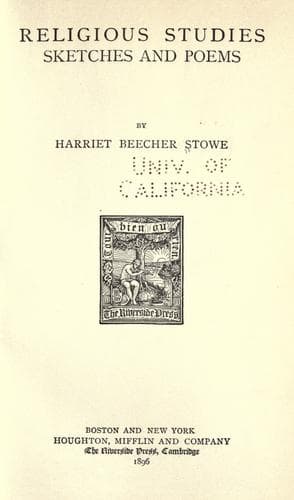
Religious Studies, Sketches and Poems — John Shaqi
Religious Studies, Sketches and PoemsStowe, Harriet Beecher
Religion
Religious Studies, Sketches and Poems
Stowe, Harriet Beecher
Religion
From the time of the first announcement to Abraham his descendants
became the recipients of a special divine training, in which every
event of their history had a forelooking to this great consummation.
They were taken into Egypt, and, after long suffering, delivered
from a deadly oppression. In the solemn hour of their deliverance
the blood of a spotless lamb--"a lamb without blemish"--was to mark
the door-posts of each dwelling with a sign of redemption. "Not a
bone of him shall be broken," said the ancient command, referring
to this typical sacrifice; and when in a later day the Apostle
John stood by the cross of Jesus and saw them break the limbs of
the other two victims and leave Jesus untouched, he said, "that it
might be fulfilled which was commanded, not a bone of Him shall be
broken."
The yearly festival which commemorated this deliverance was a yearly
prophecy in every Jewish family of the sinless Redeemer whose blood
should be their salvation. A solemn ritual was instituted, every
part of which was prophetic and symbolic. A high priest chosen from
among his brethren, who could be touched with the feelings of their
infirmities, was the only one allowed to enter that mysterious Holy
of Holies where were the mercy-seat and the cherubim, the throne
of the Invisible God. There, for the most part, unbroken stillness
and solitude reigned. Only on one memorable day of the year, while
all the congregation of Israel lay prostrate in penitence without,
this high priest entered for them with the blood of atonement into
the innermost presence of the King Invisible. Purified, arrayed in
spotless garments, and bearing on his breast--graven on precious
gems--the names of the tribes of Israel, he entered there, a yearly
symbol and prophecy of the greater High Priest, who should "not by
the blood of bulls and of goats, but by his own blood, enter at once
into the holy place, having obtained eternal redemption for us."
Thus, by a series of symbols and ceremonies which filled the entire
life of the Jew, the whole national mind was turned in an attitude
of expectancy towards the future Messiah. In the more elevated and
spiritual natures--the poets and the prophets--this was continually
bursting forth into distinct predictions. Moses says, in his last
message to Israel, "A prophet shall the Lord your God raise up unto
you from the midst of your brethren like unto me; unto Him shall ye
hearken." Our Lord referred to this prophecy when he said to the
unbelieving Jews, "Had ye believed Moses ye would have believed me,
for he wrote of me."
Public-domain text, read in full here on John Shaqi.
Reviews
Reviews
No reviews yet
Be the first to share your thoughts on this work.
Join the Discussion
Join the discussion
Sign in to leave a comment or review.
Sign InorCreate an account