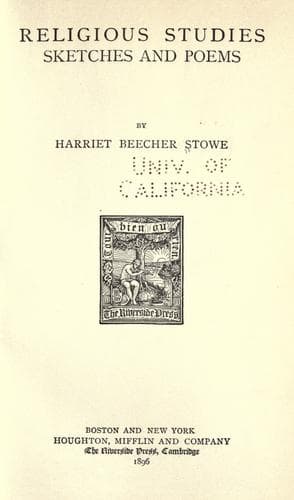
Religious Studies, Sketches and Poems — John Shaqi
Religious Studies, Sketches and PoemsStowe, Harriet Beecher
Religion
Religious Studies, Sketches and Poems
Stowe, Harriet Beecher
Religion
Tell a Hottentot or a Zulu the story of Socrates, and it excites
no very deep emotion; but, for eighteen hundred years, Hottentots,
Zulus, South Sea Islanders and savages, Greenlanders,--men, women,
and children in every land, with every variety of constitutional
habit,--have conceived such an ardent, passionate, personal love
to Jesus of Nazareth that they have been ready to face torture and
death for his sake.
"It is not for me to covet things visible or invisible," said
Polycarp, on his way to martyrdom, "if only I may obtain Jesus
Christ. The fire, the cross, the rush of wild beasts, the tearing
asunder of bones, the fracture of limbs, and the grinding to powder
of the whole body, let these, the devil's torments, come upon me,
provided only that I obtain Jesus Christ."
So felt the Christians of the first ages, and time does not cool
the ardor. There are at this present hour hundreds of thousands of
obscure men and women, humble artisans, ignorant negroes, to whom
Christ is dearer than life, and who would be capable of just this
grand devotion. It is not many years since that in the Island of
Madagascar Christian converts were persecuted, and there were those
who met death for Christ's sake with all the triumphant fervor of
primitive ages. Jesus has been the one man of whom it has been
possible to say to people of all nations, ages, and languages, "Whom
having not seen ye love, and in whom, though now ye see him not, yet
believing, ye rejoice with joy unspeakable and full of glory."
If we should embody our idea of the Son with whom Mary lived in
secure intimacy for thirty years, we should call him Love, itself.
He was not merely lovely, but he was love. He had a warming,
creative power as to love. He gave birth to new conceptions of love;
to a fervor, a devotion, a tenderness, of which before the human
soul scarcely knew its own capacity.
Napoleon asserted the divinity of Jesus from the sole fact of his
wonderful power of producing love. "I know men," he said, "and
I know Jesus was not a man;--eighteen hundred years ago he died
defeated, reviled, and yet at this hour there are thousands all over
the world who would die for him. I am defeated and overthrown, and
who cares for me now? Who fights, who conquers for me? What an abyss
between my misery and the triumph of Jesus!"
The blessedness of Mary was that she was the one human being who had
the right of ownership and intimate oneness with the Beloved. For
thirty years Jesus had only the task of living an average, quiet,
ordinary human life. He was a humble artisan, peacefully working
daily for the support of his mother. He was called from her by no
public duty; he was hers alone. When he began his public career he
transcended these limits. Then he declared that every soul that
heard the will of God, and did it, should be to him as his mother--a
declaration at which every Christian should veil his face in awe and
gratitude.
Public-domain text, read in full here on John Shaqi.
Reviews
Reviews
No reviews yet
Be the first to share your thoughts on this work.
Join the Discussion
Join the discussion
Sign in to leave a comment or review.
Sign InorCreate an account