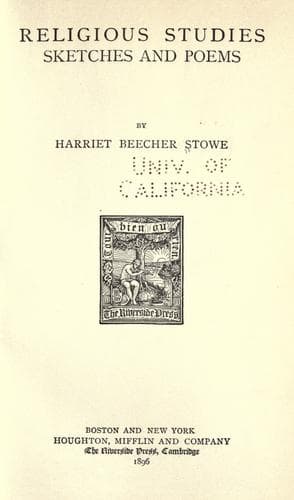
Religious Studies, Sketches and PoemsStowe, Harriet Beecher
Religion
Religious Studies, Sketches and Poems
Stowe, Harriet Beecher
Religion
We may imagine the peace, the joy, the serenity of that household of
which Jesus was the centre. He read and explained the Scriptures,
and he prayed with them, in such blessed words as those that are
recorded in St. John's Gospel. In this life of simplicity and
poverty he taught them that sweet and sacred secret of a peaceful
daily looking to God for food and raiment that can be learned only
by the poor and dependent. He made labor holy by choosing it as his
lot.
Many little incidents in Christ's life show the man of careful
domestic habits. He was in all things methodical and frugal. The
miraculous power he possessed never was used to surround him with
any profusion. He would have the fragments of the feast picked
up and stored in the baskets, "that nothing should be lost." His
illustrations show the habits of a frugal home. His parable of the
kingdom of heaven, likened to the leaven hidden in three measures
of meal, gives us to believe that doubtless he had often watched
his mother in the homely process of bread-making. The woman,
who, losing one piece of money from her little store, lights a
candle and searches diligently, brings to our mind the dwelling of
the poor where every penny has its value. His illustrations from
husbandry--ploughing, sowing, growing, the lost sheep, the ox fallen
into the pit, the hen and her chickens--all show a familiarity and
a kind sympathy with the daily habits and life interests of the
poor. Many little touches indicate, also, the personal refinement
and delicacy of his habits, the order and purity that extended to
all his ways. While he repressed self-indulgence and the profusion
of extravagant luxury, he felt keenly and justified bravely that
profusion of the heart that delights in costliness as an expression
of love.
There seems to be reason to think that the retirement and stillness
of the peasant life in Nazareth, its deeply hidden character, was
peculiarly suited to the constitutional taste both of Jesus and his
mother.
Mary seems, from the little we see of her, to have been one of those
silent, brooding women who seek solitude and meditation, whose
thoughts are expressed only confidentially to congenial natures.
There is every evidence that our Lord's individual and human nature
was in this respect peculiarly sympathetic with that of his mother.
The prophecy of Isaiah predicts this trait of his character:
"He shall not cry, nor lift up, nor cause his voice to be heard
in the street." In the commencement of his ministry we find the
same avoidance of publicity. He hushed the zeal of his disciples.
He wrought miracles with injunctions of secrecy--"See thou tell
no man." The rush of sensational popularity seemed especially
distasteful to him, and we find him after a little retiring from it.
"Come ye with me into a desert place and rest awhile," he says to
his disciples, "for there were so many coming and going that they
found no leisure so much as to eat."
Public-domain text, read in full here on John Shaqi.
Reviews
Reviews
No reviews yet
Be the first to share your thoughts on this work.
Join the Discussion
Join the discussion
Sign in to leave a comment or review.
Sign InorCreate an account