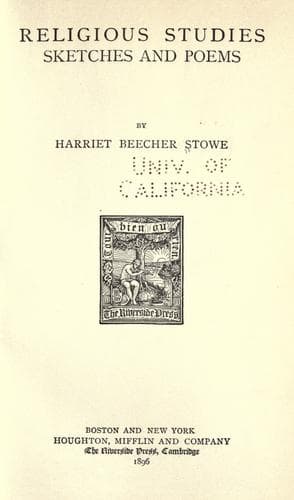
Religious Studies, Sketches and PoemsStowe, Harriet Beecher
Religion
Religious Studies, Sketches and Poems
Stowe, Harriet Beecher
Religion
"Who is my mother, and who are my brethren? And he looked around
on them that sat about him, and said, Behold my mother and my
brethren. For whosoever shall do the will of God, the same is my
brother and sister and mother."
From that noble utterance, the Song of Mary,--retained by the church
as a Magnificat,--there is evidence of a soul not only exalted by
genius and enthusiasm, but steeped in the traditions of ancient
prophecy. It is so like the Psalms of David that a verse of it,
if read out casually, might seem to be taken from them. There
is no doubt that a soul like this, when possessed of the great
secret of prophecy, devoted itself with ardor to all in the Hebrew
Scriptures which foreshadowed her son's career. She was the first
teacher of the child Jesus in the Law and the Prophets. One of
Raphael's most beautiful conceptions of her represents her sitting
thoughtfully, holding the hand of the infant Jesus, while the roll
of the prophecies lies in her lap, and her eyes are fixed on the
distance as in deep thought. There is a similar picture of her by
Palma Vecchio. The communings of Christ and his mother on these
subjects must have been so long and so intimate that she more calmly
and clearly knew exactly whither his life was tending than did his
disciples. She had been forewarned in Daniel of the time when the
Messiah was to be cut off, but not for himself; she understood,
doubtless, the deep, hidden meaning of the Psalm that describes the
last agonies, the utter abandonment of her son.
There is in her whole character a singular poise and calmness. When
the Angel of the Annunciation appeared to her she was not overcome
by the presence of a spiritual being as Daniel was, who records that
"he fell on his face and there was no strength in him." Mary, in
calm and firm simplicity, looks the angel in the face, and ponders
what the wonderful announcement may mean. When she finds that it
really does mean that she, a poor lonely maiden, is the chosen woman
of all the human race--the gainer of the crown of which every Jewish
woman had dreamed for ages--she is still calm. She does not sink
under the honor, she is not confused or overcome, but answers with
gentle submission, "Behold the handmaid of the Lord, be it unto me
according to his word."
Yet the words of the Magnificat show a keen sense of the honor and
favor done her. She exults in it with an innocent heartiness of
simplicity. "He hath regarded the low estate of his handmaid, for
from henceforth all nations shall call me blessed."
Public-domain text, read in full here on John Shaqi.
Reviews
Reviews
No reviews yet
Be the first to share your thoughts on this work.
Join the Discussion
Join the discussion
Sign in to leave a comment or review.
Sign InorCreate an account