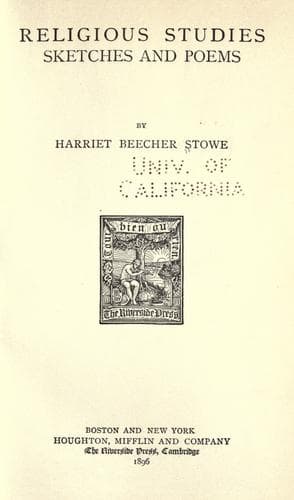
Religious Studies, Sketches and PoemsStowe, Harriet Beecher
Religion
Religious Studies, Sketches and Poems
Stowe, Harriet Beecher
Religion
It is remarkable that Mary was never in any one instance associated
in public work with Jesus. She was not among the women who are
mentioned as following and ministering unto him. She was, it seems,
in Jerusalem at the last Passover of our Lord, but it was not
with her, or at her table, that he prepared to eat the Passover.
He did that as master in his own house, with a family of little
children of his own choosing. Mary was not at the first Eucharistic
feast. Undoubtedly there was foreknowledge and divine design in
all this, and doubtless Jesus and Mary were so completely one in
will and purpose that she was of perfect accord with him in all
these arrangements. There are souls so perfectly attuned to each
other, with such an exact understanding and sympathy, that personal
presence no longer becomes a necessity. They are always with each
other in spirit, however outwardly separated. But we find her with
him once more, openly and visibly, in the hour when all others
forsook him. The delicacy of woman may cause her to shrink from the
bustle of public triumph, but when truth and holiness are brought to
public scorn she is there to defend, to suffer, to die.
Can we conceive what this mob was, that led Jesus forth to death?
Mobs in our day are brutal, but what were they then? Consider what
the times must have been when scourging was an ordinary punishment
for criminals, and crucifixion an ordinary mode of execution; what
were the sights, the sounds, the exhibitions of brutality among
which Mary and the women friends of Jesus followed him to the cross!
And Mary did not faint--did not sink. She did not fall to the earth
when an angel predicted her glory; she did not fall now, when the
sword had gone through her heart. It is all told in one word, "Now
there _stood_ by the cross of Jesus his mother." The last word that
Jesus spoke to any mortal ear was to commend her to his dearest
friend.
After the resurrection Mary appears once more among the disciples,
waiting and praying for a descent of the Holy Ghost--and then in the
sacred record we hear of her no more.
But enough is recorded of her to make her forever dear to all
Christian hearts. That Mary is now with Jesus, that there is an
intimacy and sympathy between her soul and his such as belong to no
other created being, seems certain. Nor should we suffer anything to
prevent that just love and veneration which will enable us to call
her Blessed, and to look forward to meeting her in heaven as one of
the brightest joys of that glorious world.
V
THE HOLY CHILDHOOD
In the first recorded public prayer of the Apostles after the
resurrection of our Lord he is called "THY HOLY CHILD JESUS."
The expression is a very beautiful one if we couple it with the
Master's declaration that the greatest in the kingdom of heaven is
the most like a little child, and that to become as a little child
is the first step toward fitness for the knowledge of spiritual
things.
Public-domain text, read in full here on John Shaqi.
Reviews
Reviews
No reviews yet
Be the first to share your thoughts on this work.
Join the Discussion
Join the discussion
Sign in to leave a comment or review.
Sign InorCreate an account