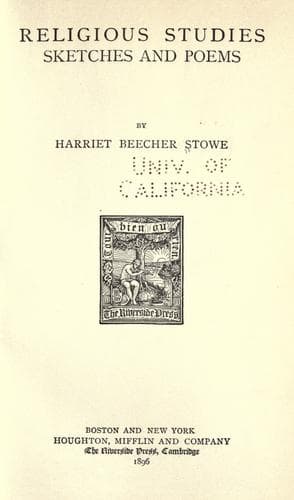
Religious Studies, Sketches and PoemsStowe, Harriet Beecher
Religion
Religious Studies, Sketches and Poems
Stowe, Harriet Beecher
Religion
It is an interesting study for the sacred season of Advent to trace
those pre-appearances of our Lord and Saviour in the advancing
history of our race. A series of readings of this sort would be
a fit preparation for the triumphs of Christmas, when he, the
long-desired, was at last given visible to man.
We shall follow a few of these early appearances of the Saviour,
in the hope that some pious hearts may be led to see those traces
of his sacred footsteps, which brighten the rugged ways of the Old
Testament history.
In the eighteenth chapter of Genesis we have an account of a long
interview of Abraham with a being in human form, whom he addresses
as Jehovah, the Judge of all the earth. We hear him plead with him
in words like these;--
"Behold now, I have taken on me to speak unto Jehovah, which am
but dust and ashes ... that be far from thee to do after this
manner, to slay the righteous with the wicked: and that the
righteous should be as the wicked. Shall not the Judge of all
the earth do right?"
What a divine reticence and composure it was, on the part of our
Lord, when afterwards he came to earth and the scoffing Jews said to
him, "Thou art not yet fifty years old, and hast thou seen Abraham?"
He did not tell them how their father Abraham had been a suppliant
at his feet ages ago, yet he must have thought of it as they thus
taunted him.
Again we read in Genesis xxviii., when Jacob left his father's house
and lay down, a lonely traveler, in the fields with a stone for his
pillow, the pitying Jesus appeared to him:--
"He dreamed, and behold a ladder set up on the earth, and the
top of it reached unto heaven; and behold the angels of God
ascending and descending upon it. And behold, Jehovah stood
above it, and said, I am Jehovah, God of Abraham, thy father."
As afterwards Jesus, at the well of Samaria, chose to disclose his
Messiahship to the vain, light-minded, guilty Samaritan woman, and
call her to be a messenger of his good to her townsmen, so now he
chose Jacob--of whom the worst we know is that he had yielded to
an unworthy plot for deceiving his father--he chose him to be the
father of a powerful nation. Afterward our Lord alludes to this
vision in one of his first conversations with Nathaniel, as given by
St. John:--
"Jesus said unto him, Because I said unto thee, I saw thee under
the fig-tree, believest thou? thou shalt see greater things than
these, Verily I say unto you, hereafter ye shall see heaven open
and the angels of God ascending and descending _upon the Son of
man_."
This same divine Patron and Presence watches over the friendless
Jacob until he becomes rich and powerful, the father of a numerous
tribe. He is returning with his whole caravan to his native land.
But the consequence of his former sin meets him on the way. Esau,
the brother whom he deceived and overreached, is a powerful prince,
and comes to meet him with a band of men.
Public-domain text, read in full here on John Shaqi.
Reviews
Reviews
No reviews yet
Be the first to share your thoughts on this work.
Join the Discussion
Join the discussion
Sign in to leave a comment or review.
Sign InorCreate an account