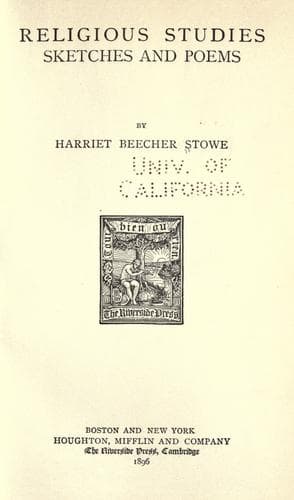
Religious Studies, Sketches and PoemsStowe, Harriet Beecher
Religion
Religious Studies, Sketches and Poems
Stowe, Harriet Beecher
Religion
Then Jacob was afraid and distressed, and applies at once to his
heavenly Helper. "I am not worthy," he says, "of all the mercy
and all the truth which thou hast shown to thy servant, for with
my staff I passed over this Jordan and now I am become two bands.
Deliver me, I pray thee, from the hand of my brother Esau, for
I fear him, lest he come and smite me and the mother with the
children." Such things were common in those days--they were possible
and too probable--and what father would not pray as Jacob prayed?
Then follows a passage of singular and thrilling character. A
mysterious stranger comes to him, dimly seen in the shadows of the
coming dawn. Is it that human Friend--that divine Jehovah? Trembling
and hoping he strives to detain him, but the stranger seeks to flee
from him. Made desperate by the agony of fear and entreaty, he
throws his arms around him and seeks to hold him. The story is told
briefly thus:--
"And Jacob was left alone. And there wrestled A MAN with him
until the breaking of day. And when he saw that he prevailed not
he touched the hollow of his thigh, and the hollow of Jacob's
thigh was out of joint as he wrestled with him. And the man
said, Let me go, for the day breaketh; and he said, I will not
let thee go except thou bless me. And he said, What is thy name?
and he said, Jacob. And he said, Thy name shall be called no
more Jacob, but Israel: for as a prince thou hast power with God
and with men, and hast prevailed. And Jacob said, I beseech thee
tell me thy name. And he said, Wherefore is it that thou dost
ask after my name? And he blessed him there."
How like is this mysterious stranger to the One in the New Testament
history who after the resurrection joined the two sorrowful
disciples on the way to Emmaus. There is the same mystery, the same
reserve in giving himself fully to the trembling human beings who
clung to him. So when the disciples came to their abode "he made
as though he would go farther," and they constrained him and he
went in. As he breaks the bread they know him, and immediately he
vanishes out of their sight.
In his dying hour (Gen. xlviii.) the patriarch Jacob, after an
earthly pilgrimage of a hundred and forty-seven years, recalls these
blessed visions of his God:--
"And Jacob said to Joseph, God Almighty appeared to me at Luz in
the land of Canaan and blessed me."
And again, blessing the children of Joseph, he says:--
"God, before whom my fathers Abraham and Isaac did walk, the God
which fed me all my life long unto this day, the Angel which
redeemed me from all evil, bless the lads."
Public-domain text, read in full here on John Shaqi.
Reviews
Reviews
No reviews yet
Be the first to share your thoughts on this work.
Join the Discussion
Join the discussion
Sign in to leave a comment or review.
Sign InorCreate an account