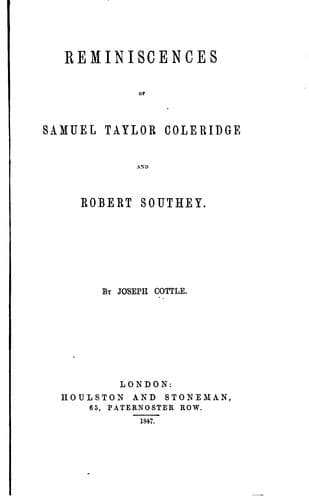
Reminiscences of Samuel Taylor Coleridge and Robert SoutheyCottle, Joseph
General
Reminiscences of Samuel Taylor Coleridge and Robert Southey
Cottle, Joseph
Authors, English -- 19th century -- Biography; Coleridge, Samuel Taylor, 1772-1834; Southey, Robert, 1774-1843
an ample scope for other philosophical speculators.
It is a demonstrative confirmation of the accuracy of Mr. Davy's
reasoning, that a few years ago, after the burning of a large mow, in the
neighbourhood of Bristol, a stratum of pure, compact, vitrified silex
appeared at the bottom, forming one continuous sheet, nearly an inch in
thickness. I secured a portion, which, with a steel, produced an
abundance of bright sparks.
Upon Mr. Coleridge's return from the north, to Bristol, where he meant to
make some little stay, I felt peculiar pleasure in introducing him to
young Mr. Davy. The interview was mutually agreeable, and that which does
not often occur, notwithstanding their raised expectations, each,
afterward, in referring to the other, expressed to me the opinion, that
his anticipations had been surpassed. They frequently met each other
under my roof, and their conversations were often brilliant; intermixed,
occasionally, with references to the scenes of their past lives.
Mr. Davy told of a Cornish young man, of philosophical habits, who had
adopted the opinion that a firm mind might endure in silence, any degree
of pain: showing the supremacy of "mind over matter." His theory once met
with an unexpected confutation. He had gone one morning to bathe in
Mount's Bay, and as he bathed, a crab griped his toe, when the young
philosopher roared loud enough to be heard at Penzance.[74]
Mr. Coleridge related the following occurrence, which he received from
his American friend, Mr. Alston, illustrating the effect produced on a
young man, at Cambridge University, near Boston, from a fancied
apparition. "A certain youth," he said, "took it into his head to convert
a Tom-Painish companion of his, by appearing as a ghost before him. He
accordingly dressed himself in the usual way, having previously extracted
the ball from the pistol which always lay near the head of his friend's
bed. Upon first awaking and seeing the apparition, A. the youth who was
to be frightened, suspecting a trick, very coolly looked his companion,
the ghost, in the face, and said, 'I know you. This is a good joke, but
you see I am not frightened. Now you may vanish.' The ghost stood still.
'Come,' said A. 'that is enough. I shall get angry. Away!' Still the
ghost moved not. Exclaimed A. 'If you do not in one minute go away, I
will shoot you.' He waited the time, deliberately levelled his pistol,
fired, and with a scream at the motionless immobility of the figure, was
convinced it was a real ghost--became convulsed, and from the fright,
afterwards died."
Public-domain text, read in full here on John Shaqi.
Reviews
Reviews
No reviews yet
Be the first to share your thoughts on this work.
Elsewhere in the archive
Join the Discussion
Join the discussion
Sign in to leave a comment or review.
Sign InorCreate an account