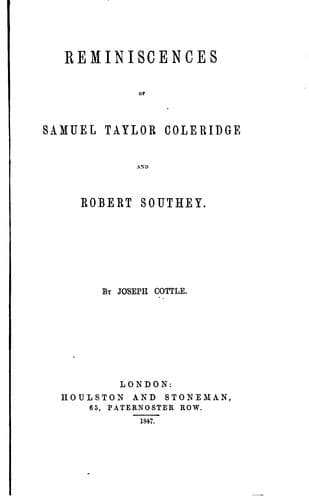
Reminiscences of Samuel Taylor Coleridge and Robert SoutheyCottle, Joseph
General
Reminiscences of Samuel Taylor Coleridge and Robert Southey
Cottle, Joseph
Authors, English -- 19th century -- Biography; Coleridge, Samuel Taylor, 1772-1834; Southey, Robert, 1774-1843
Mr. Coleridge told also of his reception at an Hessian village, after his
visit to the Hartz mountains, and the Brocken. Their party consisted of
himself, Mr. Carlyon, and the two Mr. Parrys. (sons of Dr. Parry, of
Bath--one of them the Arctic explorer). The four pedestrians entered the
village late of an evening, and repaired to the chief ale-house, wearied
with a hard day's journey, in order to be refreshed and to rest for the
night. The large room contained many of the neighbouring peasants. "What
can we have to eat?" said Mr. Coleridge. "Nothing," was the reply. "Can
we have beds?" "No," answered the master of the house. "Can we have some
straw on which to lie?" "None, none," was the reply. On which Mr.
Coleridge cried out, "Are the Hessians Christians?" To have their
Christianity doubted, was an insufferable insult, and to prove their
religion, one man in a rage, hurled a log of wood at Mr. C., which, if it
had struck him, would have laid him prostrate! But more effectually to
prove that they were Christians, "good and true," the men, in fierce
array, now marched up, and roughly drove the saucy Englanders out of the
house, to get lodgings where they could. From the extreme wrath of the
insulted peasants, the travellers were apprehensive of some worse
assault; and hurrying out of the village, weary, and hunger-smitten,
bivouacked under a tree, determined never again to question a Hessian's
Christianity, even under the gallows.
On one occasion, Mr. Coleridge entered into some of his college scenes,
to one of which I may here refer. He said that, perhaps, it was culpable
in him not to have paid more attention to his dress than he did when at
the University, but the great excluded the little. He said that he was
once walking through a street in Cambridge, leaning on the arms of two
_silk gowns_, when his own habiliments formed rather a ludicrous
contrast. His cap had the merit of having once been new; and some
untoward rents in his gown, which he had a month before intended to get
mended, left a strong tendency, in some of its posterior parts, to trail
along the ground in the form, commonly called "tatters." The three
friends were settling the exact site of Troy, or some other equally
momentous subject, when they were passed by two spruce gownsmen, one of
whom said to the other, which just caught the ear of Mr. C., "That sloven
thinks he can hide his ribbons by the gowns of his companions." Mr. C.
darted an appalling glance at him, and passed on. He now learned the
name, and acquired some particulars respecting the young man who had
offended him, and hastened home to exercise his Juvenallian talent.
Public-domain text, read in full here on John Shaqi.
Reviews
Reviews
No reviews yet
Be the first to share your thoughts on this work.
Elsewhere in the archive
Join the Discussion
Join the discussion
Sign in to leave a comment or review.
Sign InorCreate an account