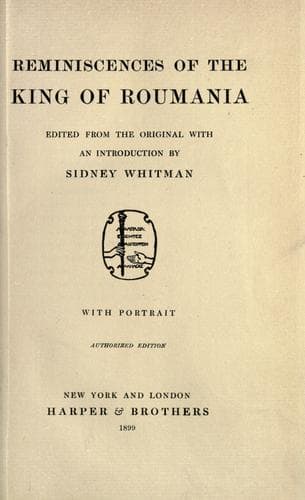
Reminiscences of the King of RoumaniaKremnitz, Mite
History
Reminiscences of the King of Roumania
Kremnitz, Mite
Carol I, King of Romania, 1839-1914; Eastern question (Balkan); Jews -- Romania; Romania -- History -- Charles I, 1866-1914
He had to begin by acquiring the difficult art of "taking people,"
and this--as the King himself admits--he only acquired gradually.
However, he possessed an inborn genius for the business of ruler.
By nature he is a practical realist whose insatiable appetite for
facts, _faits politiques_, crowds out most other interests. So he
quickly profited by experience, which, added to an independence of
judgment which he always possessed, has made him an opportunist
whose opportunity always means the welfare of his country. In
dealing with public questions he endeavours to start with the
Gladstonian open mind: _i.e._, by having no fixed opinion of his
own. He listens to all--forms his own opinion in doing so--and
invariably finishes by impressing and influencing others. He even
indirectly manipulates public opinion by constantly seeing and
conversing with a vast number of people. For in Roumania there is
no class favouritism so far as access to the monarch is concerned.
Anybody may be presented at Court, and on any Sunday afternoon all
are at liberty to call and see the King even without the formality
of an audience paper to fix an appointment.
Personal favouritism has never existed under him. In fact, so
thoroughly has he realised and carried into practice what he
considers to be his duty of personal impartiality, that he once
vouchsafed the following justification of an apparent harshness:
that a ruler must take up one and drop another as the interests of
the country require. In other words, he must not allow personal
feeling to sway him--whereas in private life he should never forsake
a friend. And yet withal King Charles is anxiously intent upon
avoiding personal responsibility--not from timidity, but from an
idea that it is irreconcilable with the dignity of a constitutional
king to put himself forward in this way. Thus not "Le Roi le veut,"
but rather "I hold it to be in the public interest that such and
such a thing should be done" is his habitual form of speech in
council with his Ministers.
One of the King's favourite aphorisms is singularly suggestive in
our talkative age: "It is not so much by what a prince _does_ as
by what he _says_ that he makes enemies!" Like all men of true
genius--or what the Germans call "geniale Naturen"--King Charles is
of simple, unaffected nature;[3] without a taint of the histrionic
in his composition, yet gifted with great reserve force of
self-repression, and rare powers of discernment and well-balanced
judgment.
[3] Lord Macaulay cites the Earl of Chatham in the following words
as the exception to this invariable rule, thus: "He was an almost
solitary instance of a man of real genius, and of brave, lofty, and
commanding spirit, without simplicity of character."--(William Pitt,
Earl of Chatham.) Macaulay's "Critical and Historical Essays."
Public-domain text, read in full here on John Shaqi.
Reviews
Reviews
No reviews yet
Be the first to share your thoughts on this work.
Join the Discussion
Join the discussion
Sign in to leave a comment or review.
Sign InorCreate an account