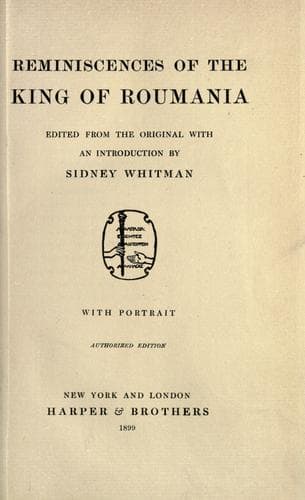
Reminiscences of the King of RoumaniaKremnitz, Mite
History
Reminiscences of the King of Roumania
Kremnitz, Mite
Carol I, King of Romania, 1839-1914; Eastern question (Balkan); Jews -- Romania; Romania -- History -- Charles I, 1866-1914
It is not generally known--but it is true, nevertheless--that the
King of Roumania is half French by descent. His grandmother on his
father's side was a Princess Murat, and his maternal grandmother,
as already mentioned, was a French lady well known to history as
Stéphanie Beauharnais, the adopted daughter of the first Napoleon,
and later, by her marriage, Princess Stéphanie of Baden. It is to
this combination in his ancestry that people have been wont to
ascribe some of the marked characteristics of the King. His personal
appearance--notably the fine clear-cut profile--undoubtedly recalls
the typical features of the old French nobility. Also the slight,
symmetrical, and graceful figure is rather French Beauharnais than
German Hohenzollern. His gift for repartee--_l'esprit du moment_,
as it is so aptly styled--is decidedly French; and perhaps not less
so his sanguine temperament, which has stood him in such good stead,
and encouraged him not to lose heart in the midst of his greatest
troubles, particularly years ago, when his subjects did not know
and value him as they do now. An abnormal capacity for work and an
absolute indifference towards every form of material enjoyment--or
gratification of the senses--have also singularly fitted him for
what posterity will probably deem to have been King Charles's most
striking vocation: that of the politician. And his success as a
politician is all the more remarkable, since his youthful training
as well as his early tastes were almost exclusively those of the
Prussian soldier. He even lacked the study of law and bureaucratic
administration, which are commonly held to be the necessary
groundwork of a political career. Yet not an atom of German
dreaminess is to be detected in him; nor aught of roughness: little
of the insensible hardness of iron; but rather something of the
fine temper of steel--the elasticity of a well-forged blade--which,
though it will show the slightest breath of damp, and bend at times,
yet flies back rigid to the straight line. Thus I am assured is
King Charles as a politician--not to be swayed or tampered with by
influences of any kind, the sober moderation of an independent
judgment has, in fact, never deserted him. It is also owing to a
felicitous temperament that he has always been able to encounter
opposition--even bitter enmity--without feeling its effect in a way
common to average mankind.
Public-domain text, read in full here on John Shaqi.
Reviews
Reviews
No reviews yet
Be the first to share your thoughts on this work.
Join the Discussion
Join the discussion
Sign in to leave a comment or review.
Sign InorCreate an account