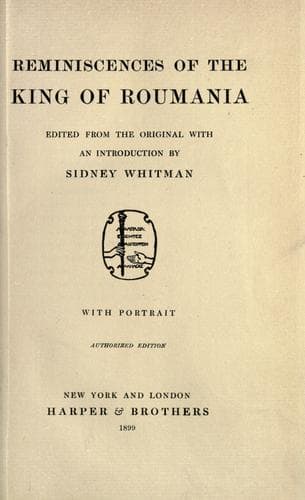
Reminiscences of the King of Roumania — John Shaqi
Reminiscences of the King of RoumaniaKremnitz, Mite
History
Reminiscences of the King of Roumania
Kremnitz, Mite
Carol I, King of Romania, 1839-1914; Eastern question (Balkan); Jews -- Romania; Romania -- History -- Charles I, 1866-1914
Moldavia and Wallachia, in spite of the ever increasing desire
of their inhabitants for union and for the development of their
resources, so long restrained, were condemned to remain for ever in
their lamentable condition by the jealousy of their three powerful
neighbours.
At length came the February Revolution of 1848 in Paris, the effects
of which were felt even in far Roumania. An insurrection arose in
Moldavia: the Hospodar was forced to abdicate; and a Provisional
Government, the _Lieutenance Princière_,[7] was formed at Bucharest,
and proceeded to frame a constitution embodying the freedom of
the Press, the abolition of serfdom and all the privileges of the
nobility. The earlier state of affairs was, however, restored on
September 25 of the same year by the combined action of the Russians
and the Turks, with the result that the Principalities for a time
lost even the last remnants of their former independence, and the
power of the Hospodars was hedged in with such narrow restrictions
by the Treaty of Balta Liman (May 1, 1849) that they could undertake
no initiative without the sanction of the Russian and Turkish
commissaries, under whose control they were placed.
[7] The so-called _Lieutenance Princière_ was a kind of governorship
or regency which was formed after Prince Kusa's fall, and consisted
of the chiefs of all the recognised political parties.
The Crimean War brought with it emancipation from the Russian
protectorate, but although the situation was now improving, much
was still necessary before the Roumanians could regain their
domestic independence. A French protector had taken the place of
the Russian. The pressure, it is true, was by no means so severe,
nor was it felt so directly as formerly, yet the country perforce
suffered no inconsiderable damage, both moral and material, from the
half-voluntary, half-compulsory compliance with the wishes of the
French ruler. Napoleon wished to elevate Roumania, the "Latin sister
nation," into a French dependency, and thereby to make France the
decisive factor in the Oriental question. A willing tool was found
in the person of the new Hospodar of the now united Principalities,
and thenceforth everything was modelled upon French pattern.
An international Commission assembled in Bucharest in 1857, together
with a Divan convoked by an Imperial Firman for Moldavia and
Wallachia, to consider the question of the future position of the
Danubian Principalities. The deliberations of these two bodies,
however, resulted in nothing, as neither the Sublime Porte nor the
Great Powers were inclined to agree to the programme submitted
to them, the main features of which were: the union of the two
Principalities as a neutral, autonomous state under the hereditary
sovereignty of a prince of a European dynasty, and the introduction
of a constitution. A conference held at Paris, on the other hand,
decided that each Principality should elect a native Hospodar,
subject to the Sultan's confirmation.
Public-domain text, read in full here on John Shaqi.
Reviews
Reviews
No reviews yet
Be the first to share your thoughts on this work.
Join the Discussion
Join the discussion
Sign in to leave a comment or review.
Sign InorCreate an account