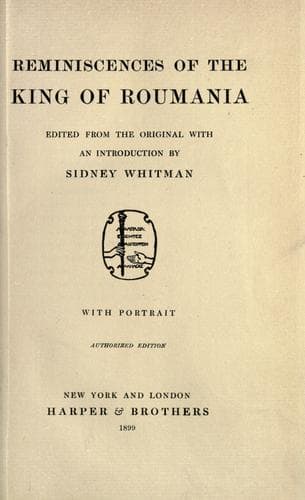
Reminiscences of the King of RoumaniaKremnitz, Mite
History
Reminiscences of the King of Roumania
Kremnitz, Mite
Carol I, King of Romania, 1839-1914; Eastern question (Balkan); Jews -- Romania; Romania -- History -- Charles I, 1866-1914
Since the end of the eighteenth century the Danubian Principalities
have attracted the unenviable notice of Russia, whose objective,
Constantinople, is covered by them. In less than a century, from
1768 to 1854, these unfortunate countries suffered no less than six
Russian occupations, and as many reconquests by the Turks. It speaks
highly for the national spirit of the Roumanians that they should
have borne the miseries entailed by these wars without relapsing
into abject callousness and apathy; and that, on the contrary, the
memory of their former national independence should have continued
to gather fresh life, and that their wish to shake off the yoke of
their bondage, be it Russian or Turkish, should have grown stronger
with the lapse of time. The Hospodars, appointed by the Russians,
were hindered in every way by the Turks in their task of awakening
the national spirit and preparing the way for the regeneration of
their enslaved people. Besides this, many of these Hospodars were
prejudiced against the introduction of reforms which could only
endanger their own interests and positions. They were, therefore,
far more disposed to seek the protection of foreign States than to
rely upon the innate strength of the people they governed. Such were
the causes that hindered the development of the moral and material
resources of the Roumanian nation.
The ideas from time to time conceived by the rulers of Russia
for the unification of the Principalities were based solely on
selfish aims and considerations. Thus, for instance, a letter dated
September 10, 1782, from Catherine II., who gave the Russian Empire
its present shape and direction, to the Emperor Joseph II., shows
clearly that the state then proposed, consisting of Wallachia,
Moldavia and Bessarabia, was to be merely a Russian outpost,
governed by a Russian nominee, against the Ottoman Empire. Even in
this century (1834) Russia would have been prepared to further the
unification of the Principalities, if only they and the other Great
Powers had declared themselves content to accept a ruler drawn from
the Imperial House of Russia, or some closely allied prince. As,
however, this was not the case, the Russian project was laid aside
in favour of a policy of suppressing the national spirit by means
of the Czars influence as protector. The Sublime Porte, on the
other hand, was straining every nerve to maintain the prevailing
state of affairs. And finally, Austria, the third neighbour of the
Principalities, hesitated between its desire to gain possession
of the mouths of the Danube by annexing Wallachia and Moldavia,
and its disinclination to increase the number of its Roumanian
subjects by four or five millions, and thereby to strengthen those
incompatible elements beyond the limits of prudence. At the same
time Austria looked upon the interior development of Roumania with
an even more unfavourable eye than Russia, and it seemed as though
Public-domain text, read in full here on John Shaqi.
Reviews
Reviews
No reviews yet
Be the first to share your thoughts on this work.
Join the Discussion
Join the discussion
Sign in to leave a comment or review.
Sign InorCreate an account