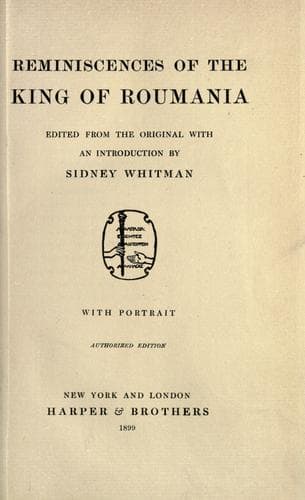
Reminiscences of the King of RoumaniaKremnitz, Mite
History
Reminiscences of the King of Roumania
Kremnitz, Mite
Carol I, King of Romania, 1839-1914; Eastern question (Balkan); Jews -- Romania; Romania -- History -- Charles I, 1866-1914
The subject-matter deals with a period of over twenty-five years
in the life of a young European nation, in the course of which she
gained her independence and strove successfully to retain it, whilst
more than trebling her resources in peaceful work. In this eventful
period greater changes have taken place in the balance of power in
Europe than in many preceding centuries. A republic has replaced
a monarchy in France, and also on the other side of the Atlantic,
in Brazil, since the days when a young captain of a Prussian
guard regiment, a scion of the House of Hohenzollern, set himself
single-handed the Sisyphean task of establishing a constitutional
representative monarchy on a soil where hitherto periodical
conspiracies and revolts had run riot luxuriously. Just here,
however, our democratic age has witnessed the realisation of the
problem treated by Macchiavelli in "Il Principe"--the self-education
of a prince.
To-day, the man who thirty-three years ago came down the Danube as
a perfect stranger--practically alone, without tried councillors or
adherents--is to all intents and purposes the omnipotent ruler of a
country which owes its independence and present position entirely
to his statesmanship. Nor can there be much doubt that but for him
Roumania and the Lower Danube might be now little more than a name
to the rest of Europe--as, indeed, they were in the past.
II
King Charles of Roumania is the second son of the late Prince
Charles Anthony[2] of Hohenzollern-Sigmaringen: the elder South
German Roman Catholic branch of the House of Hohenzollern, of
which the German Emperor is the chief. Until the year 1849 the
Hohenzollern-Sigmaringens, whose dominions are situated between
Württemberg and Baden, near the spot where the Danube rises in the
Black Forest, possessed full sovereign rights as the head of one of
the independent principalities of the German Confederation. These
sovereign rights of his own and his descendants Prince Charles
Anthony formally and voluntarily ceded to Prussia on December 7,
1849. Of him we are credibly informed:
"Prince Charles Anthony lives in the history of the German people
as a man of liberal thought and high character, who of his own
free will gave up his sovereign prerogative for the sake of the
cause of German Unity. His memory is green in the hearts of his
children as the ideal of a father, who--for all his strictness and
discipline--was not feared, but ever loved and honoured, by his
family. He was always the best friend and adviser of his grown-up
sons." His letters to his son Charles, which are frequently quoted
in the present memoir, fully bear out this testimony to the Prince's
intimate, almost ideal, relationship with his children, as also to
the magnanimity with which he is universally credited.
[2] This Prince always wrote his name Karl Anton, as a double name:
hence the retention here.
Public-domain text, read in full here on John Shaqi.
Reviews
Reviews
No reviews yet
Be the first to share your thoughts on this work.
Join the Discussion
Join the discussion
Sign in to leave a comment or review.
Sign InorCreate an account