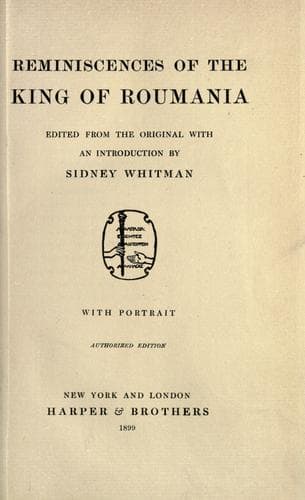
Reminiscences of the King of RoumaniaKremnitz, Mite
History
Reminiscences of the King of Roumania
Kremnitz, Mite
Carol I, King of Romania, 1839-1914; Eastern question (Balkan); Jews -- Romania; Romania -- History -- Charles I, 1866-1914
Of the King's mother--Princess Josephine of Baden--we learn:
"Princess Josephine was deeply religious without being in the least
bigoted. Her unselfishness earned for her the love and devotion of
all those who knew her. As a wife and a mother her life was one of
exceptional harmony and happiness. The great deference which King
Charles has always shown to the other sex has its source in the
veneration which he felt for his mother."
Prince Charles was born on April 20, 1839, at the ancestral
castle of the Hohenzollerns at Sigmaringen on the Danube, then
ruled over by his grandfather, the reigning Prince Charles of
Hohenzollern-Sigmaringen. The castle was not in those days the
treasury of art and history which it is at the present day. The
grandfatherly _régime_ was of a patriarchal, almost despotic kind:
every detail of household affairs was regulated with a view to
strict economy. Though, perhaps, unpleasant at times, all this
proved to be invaluable training for the young Prince, whose
ultimate destiny it was to rule over one of the most extravagant
peoples in Europe. Punctuality was strictly enforced: at nine
o'clock the old Prince wound up his watch as a sign that the day
was over, and at ten darkness and silence reigned supreme over the
household.
Prince Charles was a delicate child, and was considered so
throughout his early manhood, though in reality his health and
bodily powers left little to be desired. The first happy years of
his childhood were passed at Sigmaringen and the summer residences
of Inzigkofen and Krauchenwies. This peaceful life was broken by
a visit in 1846 to his maternal grandmother, the Grand Duchess
Stéphanie of Baden. On this occasion Prince Charles attracted the
attention and interest of Mme. Hortense Cornu, the intimate friend
and confidant of Prince Louis Napoleon--later Napoleon III.
It cannot be said that the young Prince progressed very rapidly in
his studies; but though he learned slowly, his memory proved most
retentive. His naturally independent and strong character, moreover,
prevented him from adopting outside opinions too readily, and this
trait he retained in after years. For though as King of Roumania he
is ever willing to listen to the opinion of others, the decision
invariably remains in his own hands.
Public-domain text, read in full here on John Shaqi.
Reviews
Reviews
No reviews yet
Be the first to share your thoughts on this work.
Join the Discussion
Join the discussion
Sign in to leave a comment or review.
Sign InorCreate an account