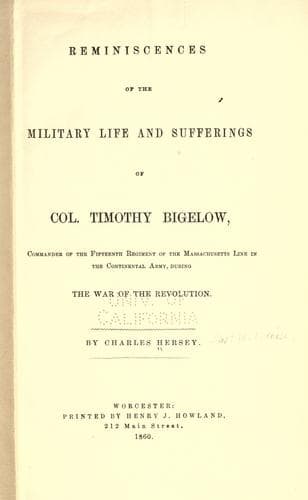
Reminiscences of the Military Life and Sufferings of Col. Timothy Bigelow, Commander of the Fifteenth Regiment of the Massachusetts Line in the Continental Army, during the War of the RevolutionHersey, Charles
History
Reminiscences of the Military Life and Sufferings of Col. Timothy Bigelow, Commander of the Fifteenth Regiment of the Massachusetts Line in the Continental Army, during the War of the Revolution
Hersey, Charles
Bigelow, Timothy, 1739-1790; United States -- History -- Revolution, 1775-1783; United States. Continental Army -- Military life
The history of Col. Bigelow is so interwoven with that of the
Revolution, that it is difficult to separate the two. We shall
therefore, give in this chapter a short account of the bloody butchery
of the inhabitants of that beautiful little colony at Wyoming, and what
Col. Bigelow thought of that demoniac cruelty, the bare remembrance of
which makes us shudder. Wilkesbarre is the shire town of Luzerne county,
Pa. It is situated in the Wyoming valley, one hundred and fourteen miles
northeast from Harrisburg, and one hundred and twenty northwest from
Philadelphia. This place was settled by emigrants from Connecticut in
1773, under the auspices of one Col. Durkee, who gave it the compound
name it bears in honor of two eminent and zealous advocates of the
American cause in the British parliament, Wilkes and Barre. Wyoming
contained eight townships, each containing a square of five miles,
beautifully situated on both sides of the Susquehanna. Wilkesbarre is
one of those towns. The inhabitants of this beautiful valley were much
engaged in their country's cause, and nearly one thousand of their
young men had joined the army, and were absent from home. Most of those
remaining at home were tories, although these were not so numerous as
the friends of liberty. Yet they formed an alliance with the Indians,
and the first of July there appeared before the fort at Wilkesbarre
about sixteen hundred armed men, two-thirds of which were tories and
one-third Indians. The colony of Wyoming could muster only about five
hundred men. In this condition, the tories and Indians fell upon them,
and put them nearly all to death; only about sixty escaped. Never was a
rout so deplorable; never was a massacre accompanied with so many
horrors. The barbarians took the men, women and children promiscuously
into houses and barracks, and set fire to them and consumed them all,
listening, delighted, to hear the moans and shrieks of the expiring
multitude.
Public-domain text, read in full here on John Shaqi.
Reviews
Reviews
No reviews yet
Be the first to share your thoughts on this work.
Join the Discussion
Join the discussion
Sign in to leave a comment or review.
Sign InorCreate an account