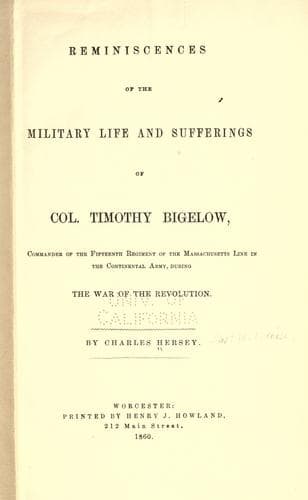
Reminiscences of the Military Life and Sufferings of Col. Timothy Bigelow, Commander of the Fifteenth Regiment of the Massachusetts Line in the Continental Army, during the War of the Revolution — John Shaqi
Reminiscences of the Military Life and Sufferings of Col. Timothy Bigelow, Commander of the Fifteenth Regiment of the Massachusetts Line in the Continental Army, during the War of the RevolutionHersey, Charles
History
Reminiscences of the Military Life and Sufferings of Col. Timothy Bigelow, Commander of the Fifteenth Regiment of the Massachusetts Line in the Continental Army, during the War of the Revolution
Hersey, Charles
Bigelow, Timothy, 1739-1790; United States -- History -- Revolution, 1775-1783; United States. Continental Army -- Military life
It was said by one of Col. Bigelow's men, who was an intimate
acquaintance of the writer of this article, and who was wounded at that
time, that, at the time he fell, Col. Bigelow seized his musket from
him, and fought more like a tiger than like a man. This man was Mr.
Solomon Parsons, whose son now occupies and owns the same farm on which
his father died, on Apricot street, in this city. Col. Bigelow with his
regiment had to retire, but was soon met by Washington, with the main
army, who was moving up to the rescue. After the troops of Lee and
Lafayette had been rallied, the whole army turned upon the enemy, and
then came the tug of war, for "Greek met Greek." The English, flushed
with the advantages they had got, and the Americans under the command of
their own beloved Washington, many of whom had never fought before by
his side, were determined to retake the field, or die in the attempt.
The conflict was now terrible indeed, and in the midst of flame, and
smoke, and metal hail, Bigelow was conspicuous. The English were
repulsed and driven to the woods. The Americans retake the field; night
comes on; the whole American army rest on their arms through the night,
that they may renew the attack with the dawn of day; day comes on, and
the British army has fled, as one of their officers said by moonlight,
but it so happened that the moon set that night at 10 o'clock, being but
four days old.
Such was the issue of the battle of Freehold, or of Monmouth, as the
Americans call it. We have now traced the military history of Col.
Bigelow from April 19, 1775, to June 28, 1778.
VIII.
THE SLAUGHTER AT WYOMING.
Public-domain text, read in full here on John Shaqi.
Reviews
Reviews
No reviews yet
Be the first to share your thoughts on this work.
Join the Discussion
Join the discussion
Sign in to leave a comment or review.
Sign InorCreate an account