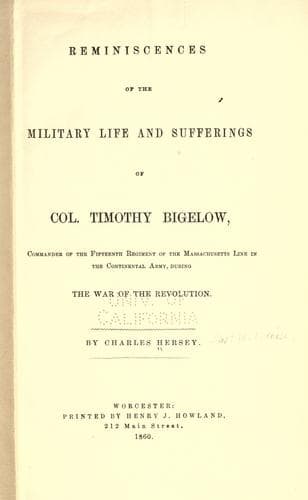
Reminiscences of the Military Life and Sufferings of Col. Timothy Bigelow, Commander of the Fifteenth Regiment of the Massachusetts Line in the Continental Army, during the War of the RevolutionHersey, Charles
History
Reminiscences of the Military Life and Sufferings of Col. Timothy Bigelow, Commander of the Fifteenth Regiment of the Massachusetts Line in the Continental Army, during the War of the Revolution
Hersey, Charles
Bigelow, Timothy, 1739-1790; United States -- History -- Revolution, 1775-1783; United States. Continental Army -- Military life
About this time a large herd of cattle was driven into the camp from New
Jersey and Connecticut. Worcester had sent Col. Bigelow's regiment
sixty-two sets of shirts, shoes and stockings, as their proportion for
the army. Other towns did their part. Worcester sent L78 in lawful
money, which was taken up at the Old South church after divine service.
Now the Marquis de la Fayette, with his money and with the French
troops, had arrived; now Count D'Estaing, with his powerful fleet, were
in the American waters; now Gen. Gates, with the remainder of the
northern army, had arrived to join the army of Washington. Spring comes;
and the day that the English abandon Philadelphia, the American army
leaves Valley Forge, to watch their movements. They cross the Delaware
at Coryell's Ferry, and take post at Hopewell; they do not venture to
cross the Raritan. The English reach Allentown; Gen. Lee occupies
Englishtown; Washington encamped at Cranberry; Morgan and Col. Bigelow
are harassing the right flank of the English. The British, now upon the
heights of Freehold, pass all their baggage to the hills of Middletown
for safety, and then comes the battle of Monmouth.
VII.
THE BATTLE OF MONMOUTH.
The battle of Monmouth, so called by the Americans, was fought in
Freehold, Monmouth county, N. J., situated thirty-five miles southeast
from Trenton. The commander-in-chief had detached two brigades to the
support of Gen. Wayne, who had been sent on as a vanguard, and had
already come up with the British rear. These two brigades were commanded
by Gens. Lee and Lafayette. At this time Col. Bigelow was under the
command of Gen. Lafayette. This vanguard of the American army had so
severely galled the rear of the British, that Gen. Clinton resolved to
wheel his whole army and put the Americans to flight at the point of the
bayonet. For a short time the conflict was severe. At length Gen. Lee
gave way, for which he was afterwards court-martialed and suspended for
one year. The light horse, also, of Lafayette's brigade, gave way, and
nothing of that celebrated vanguard but Col. Bigelow's regiment, with
two or three other regiments, remained. It was said that if Gen. Lee had
stood his ground, as he might have done, a decisive victory would have
been gained. Col. Bigelow's regiment was the last to quit the field.
Public-domain text, read in full here on John Shaqi.
Reviews
Reviews
No reviews yet
Be the first to share your thoughts on this work.
Join the Discussion
Join the discussion
Sign in to leave a comment or review.
Sign InorCreate an account