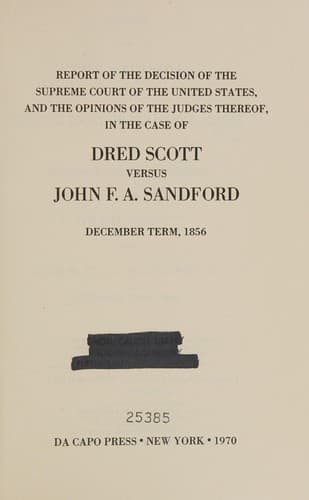
Report of the Decision of the Supreme Court of the United States, and the Opinions of the Judges Thereof, in the Case of Dred Scott versus John F. A. Sandford: December Term, 1856.United States. Supreme Court
History
Report of the Decision of the Supreme Court of the United States, and the Opinions of the Judges Thereof, in the Case of Dred Scott versus John F. A. Sandford: December Term, 1856.
United States. Supreme Court
Scott, Dred, 1809-1858; Slavery -- United States
them to perpetual liberty, is a specimen of these laws.
The earliest publicist who has discussed this subject is Bodin, a
jurist of the sixteenth century, whose work was quoted in the early
discussions of the courts in France and England on this subject. He
says: "In France, although there be some remembrance of old servitude,
yet it is not lawful here to make a slave or to buy any one of others,
insomuch as the slaves of strangers, so soon as they set their foot
within France, become frank and free, as was determined by an old
decree of the court of Paris against an ambassador of Spain, who had
brought a slave with him into France." He states another case, which
arose in the city of Toulouse, of a Genoese merchant, who had carried
a slave into that city on his voyage from Spain; and when the matter
was brought before the magistrates, the "procureur of the city, out of
the records, showed certain ancient privileges given unto them of
Tholouse, wherein it was granted that slaves, so soon as they should
come into Tholouse, should be free." These cases were cited with much
approbation in the discussion of the claims of the West India slaves
of Verdelin for freedom, in 1738, before the judges in admiralty, (15
Causes Celebres, p. 1; 2 Masse Droit Com., sec. 58,) and were
reproduced before Lord Mansfield, in the cause of Somersett, in 1772.
Of the cases cited by Bodin, it is to be observed that Charles V of
France exempted all the inhabitants of Paris from serfdom, or other
feudal incapacities, in 1371, and this was confirmed by several of his
successors, (3 Dulaire Hist. de Par., 546; Broud. Cout. de Par., 21,)
and the ordinance of Toulouse is preserved as follows: "_Civitas
Tholosana fuit et erit sine fine libera, adeo ut servi et ancillae,
sclavi et sclavae, dominos sive dominas habentes, cum rebus vel sine
rebus suis, ad Tholosam vel infra terminos extra urbem terminatos
accedentes acquirant libertatem_." (Hist. de Langue, tome 3, p. 69;
Ibid. 6, p. 8; Loysel Inst., b. 1, sec. 6.)
The decisions were made upon special ordinances, or charters, which
contained positive prohibitions of slavery, and where liberty had been
granted as a privilege; and the history of Paris furnishes but little
support for the boast that she was a "_sacro sancta civitas_," where
liberty always had an asylum, or for the "self-complacent rhapsodies"
of the French advocates in the case of Verdelin, which amused the
grave lawyers who argued the case of Somersett. The case of Verdelin
was decided upon a special ordinance, which prescribed the conditions
on which West India slaves might be introduced into France, and which
had been disregarded by the master.
Public-domain text, read in full here on John Shaqi.
Reviews
Reviews
No reviews yet
Be the first to share your thoughts on this work.
Elsewhere in the archive
Join the Discussion
Join the discussion
Sign in to leave a comment or review.
Sign InorCreate an account