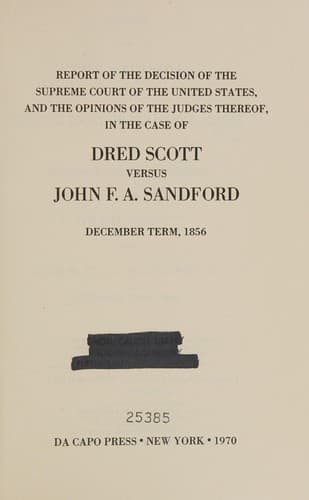
Report of the Decision of the Supreme Court of the United States, and the Opinions of the Judges Thereof, in the Case of Dred Scott versus John F. A. Sandford: December Term, 1856.United States. Supreme Court
History
Report of the Decision of the Supreme Court of the United States, and the Opinions of the Judges Thereof, in the Case of Dred Scott versus John F. A. Sandford: December Term, 1856.
United States. Supreme Court
Scott, Dred, 1809-1858; Slavery -- United States
The case of Somersett was that of a Virginia slave carried to England
by his master in 1770, and who remained there two years. For some
cause, he was confined on a vessel destined to Jamaica, where he was
to be sold. Lord Mansfield, upon a return to a _habeas corpus_, states
the question involved. "Here, the person of the slave himself," he
says, "is the immediate subject of inquiry, Can any dominion,
authority, or coercion, be exercised in this country, according to the
American laws?" He answers: "The difficulty of adopting the relation,
without adopting it in all its consequences, is indeed extreme, and
yet many of those consequences are absolutely contrary to the
municipal law of England." Again, he says: "The return states that the
slave departed, and refused to serve; whereupon, he was kept to be
sold abroad." "So high an act of dominion must be recognised by the
law of the country where it is used. The power of the master over his
slave has been extremely different in different countries." "The state
of slavery is of such a nature, that it is incapable of being
introduced on any reasons, moral or political, but only by positive
law, which preserves its force long after the reasons, occasion, and
time itself, from whence it was created, are erased from the memory.
It is so odious, that nothing can be suffered to support it but
positive law." That there is a difference in the systems of States,
which recognise and which do not recognise the institution of slavery,
cannot be disguised. Constitutional law, punitive law, police,
domestic economy, industrial pursuits, and amusements, the modes of
thinking and of belief of the population of the respective
communities, all show the profound influence exerted upon society by
this single arrangement. This influence was discovered in the Federal
Convention, in the deliberations on the plan of the Constitution. Mr.
Madison observed, "that the States were divided into different
interests, not by their difference of size, but by other
circumstances; the most material of which resulted partly from
climate, but principally from the effects of their having or not
having slaves. These two causes concur in forming the great division
of interests in the United States."
Public-domain text, read in full here on John Shaqi.
Reviews
Reviews
No reviews yet
Be the first to share your thoughts on this work.
Elsewhere in the archive
Join the Discussion
Join the discussion
Sign in to leave a comment or review.
Sign InorCreate an account