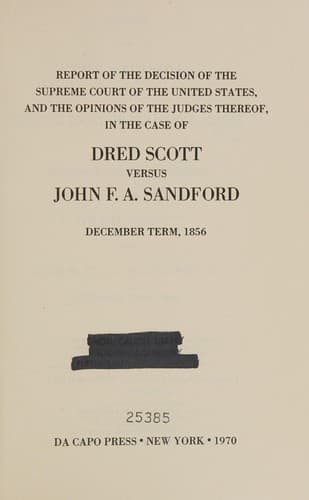
Report of the Decision of the Supreme Court of the United States, and the Opinions of the Judges Thereof, in the Case of Dred Scott versus John F. A. Sandford: December Term, 1856.United States. Supreme Court
History
Report of the Decision of the Supreme Court of the United States, and the Opinions of the Judges Thereof, in the Case of Dred Scott versus John F. A. Sandford: December Term, 1856.
United States. Supreme Court
Scott, Dred, 1809-1858; Slavery -- United States
In discussing this question, we must not confound the rights of
citizenship which a State may confer within its own limits, and the
rights of citizenship as a member of the Union. It does not by any
means follow, because he has all the rights and privileges of a
citizen of a State, that he must be a citizen of the United States. He
may have all of the rights and privileges of the citizen of a State,
and yet not be entitled to the rights and privileges of a citizen in
any other State. For, previous to the adoption of the Constitution of
the United States, every State had the undoubted right to confer on
whomsoever it pleased the character of citizen, and to endow him with
all its rights. But this character of course was confined to the
boundaries of the State, and gave him no rights or privileges in other
States beyond those secured to him by the laws of nations and the
comity of States. Nor have the several States surrendered the power of
conferring these rights and privileges by adopting the Constitution of
the United States. Each State may still confer them upon an alien, or
any one it thinks proper, or upon any class or description of persons;
yet he would not be a citizen in the sense in which that word is used
in the Constitution of the United States, nor entitled to sue as such
in one of its courts, nor to the privileges and immunities of a
citizen in the other States. The rights which he would acquire would
be restricted to the State which gave them. The Constitution has
conferred on Congress the right to establish an uniform rule of
naturalization, and this right is evidently exclusive, and has always
been held by this court to be so. Consequently, no State, since the
adoption of the Constitution, can by naturalizing an alien invest him
with the rights and privileges secured to a citizen of a State under
the Federal Government, although, so far as the State alone was
concerned, he would undoubtedly be entitled to the rights of a
citizen, and clothed with all the rights and immunities which the
Constitution and laws of the State attached to that character.
It is very clear, therefore, that no State can, by any act or law of
its own, passed since the adoption of the Constitution, introduce a
new member into the political community created by the Constitution of
the United States. It cannot make him a member of this community by
making him a member of its own. And for the same reason it cannot
introduce any person, or description of persons, who were not intended
to be embraced in this new political family, which the Constitution
brought into existence, but were intended to be excluded from it.
Public-domain text, read in full here on John Shaqi.
Reviews
Reviews
No reviews yet
Be the first to share your thoughts on this work.
Join the Discussion
Join the discussion
Sign in to leave a comment or review.
Sign InorCreate an account