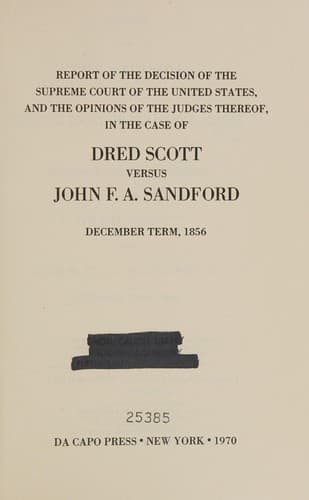
Report of the Decision of the Supreme Court of the United States, and the Opinions of the Judges Thereof, in the Case of Dred Scott versus John F. A. Sandford: December Term, 1856. — John Shaqi
Report of the Decision of the Supreme Court of the United States, and the Opinions of the Judges Thereof, in the Case of Dred Scott versus John F. A. Sandford: December Term, 1856.United States. Supreme Court
History
Report of the Decision of the Supreme Court of the United States, and the Opinions of the Judges Thereof, in the Case of Dred Scott versus John F. A. Sandford: December Term, 1856.
United States. Supreme Court
Scott, Dred, 1809-1858; Slavery -- United States
The words "people of the United States" and "citizens" are synonymous
terms, and mean the same thing. They both describe the political body
who, according to our republican institutions, form the sovereignty,
and who hold the power and conduct the Government through their
representatives. They are what we familiarly call the "sovereign
people," and every citizen is one of this people, and a constituent
member of this sovereignty. The question before us is, whether the
class of persons described in the plea in abatement compose a portion
of this people, and are constituent members of this sovereignty? We
think they are not, and that they are not included, and were not
intended to be included, under the word "citizens" in the
Constitution, and can therefore claim none of the rights and
privileges which that instrument provides for and secures to citizens
of the United States. On the contrary, they were at that time
considered as a subordinate and inferior class of beings, who had
been subjugated by the dominant race, and, whether emancipated or not,
yet remained subject to their authority, and had no rights or
privileges but such as those who held the power and the Government
might choose to grant them.
It is not the province of the court to decide upon the justice or
injustice, the policy or impolicy, of these laws. The decision of that
question belonged to the political or law-making power; to those who
formed the sovereignty and framed the Constitution. The duty of the
court is, to interpret the instrument they have framed, with the best
lights we can obtain on the subject, and to administer it as we find
it, according to its true intent and meaning when it was adopted.
Public-domain text, read in full here on John Shaqi.
Reviews
Reviews
No reviews yet
Be the first to share your thoughts on this work.
Join the Discussion
Join the discussion
Sign in to leave a comment or review.
Sign InorCreate an account