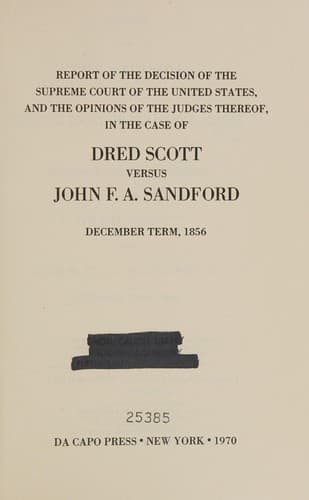
Report of the Decision of the Supreme Court of the United States, and the Opinions of the Judges Thereof, in the Case of Dred Scott versus John F. A. Sandford: December Term, 1856.United States. Supreme Court
History
Report of the Decision of the Supreme Court of the United States, and the Opinions of the Judges Thereof, in the Case of Dred Scott versus John F. A. Sandford: December Term, 1856.
United States. Supreme Court
Scott, Dred, 1809-1858; Slavery -- United States
This is a necessary consequence, resulting from the nature of the
Federal Constitution, which is a federal compact among the States,
establishing a limited Government, with powers delegated by the people
of distinct and independent communities, who reserved to their State
Governments, and to themselves, the powers they did not grant. This
claim to impose a restriction upon the people of Missouri involved a
denial of the constitutional relations between the people of the
States and Congress, and affirmed a concurrent right for the latter,
with their people, to constitute the social and political system of
the new States. A successful maintenance of this claim would have
altered the basis of the Constitution. The new States would have
become members of a Union defined in part by the Constitution and in
part by Congress. They would not have been admitted to "this Union."
Their sovereignty would have been restricted by Congress as well as
the Constitution. The demand was unconstitutional and subversive, but
was prosecuted with an energy, and aroused such animosities among the
people, that patriots, whose confidence had not failed during the
Revolution, began to despair for the Constitution.[4] Amid the utmost
violence of this extraordinary contest, the expedient contained in the
eighth section of this act was proposed, to moderate it, and to avert
the catastrophe it menaced. It was not seriously debated, nor were its
constitutional aspects severely scrutinized by Congress. For the first
time, in the history of the country, has its operation been embodied
in a case at law, and been presented to this court for their judgment.
The inquiry is, whether there are conditions in the Constitutions of
the Territories which subject the capacity and _status_ of persons
within their limits to the direct action of Congress. Can Congress
determine the condition and _status_ of persons who inhabit the
Territories?
[Footnote 4: Mr. Jefferson wrote: "The Missouri question is the most
portentous one that ever threatened our Union. In the gloomiest
moments of the revolutionary war, I never had any apprehension equal
to that I feel from this source."]
Public-domain text, read in full here on John Shaqi.
Reviews
Reviews
No reviews yet
Be the first to share your thoughts on this work.
Elsewhere in the archive
Join the Discussion
Join the discussion
Sign in to leave a comment or review.
Sign InorCreate an account