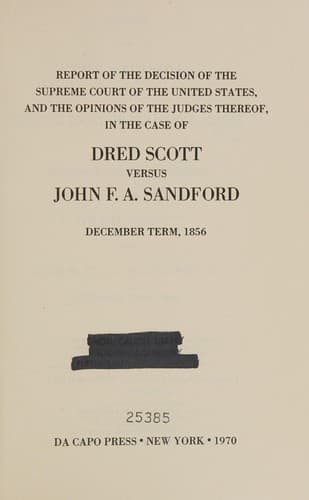
Report of the Decision of the Supreme Court of the United States, and the Opinions of the Judges Thereof, in the Case of Dred Scott versus John F. A. Sandford: December Term, 1856.United States. Supreme Court
History
Report of the Decision of the Supreme Court of the United States, and the Opinions of the Judges Thereof, in the Case of Dred Scott versus John F. A. Sandford: December Term, 1856.
United States. Supreme Court
Scott, Dred, 1809-1858; Slavery -- United States
The Constitution permits Congress to dispose of and to make all
needful rules and regulations respecting the territory or other
property belonging to the United States. This power applies as well to
territory belonging to the United States within the States, as beyond
them. It comprehends all the public domain, wherever it may be. The
argument is, that the power to make "ALL needful rules and
regulations" "is a power of legislation," "a full legislative power;"
"that it includes all subjects of legislation in the territory," and
is without any limitations, except the positive prohibitions which
affect all the powers of Congress. Congress may then regulate or
prohibit slavery upon the public domain within the new States, and
such a prohibition would permanently affect the capacity of a slave,
whose master might carry him to it. And why not? Because no power has
been conferred on Congress. This is a conclusion universally admitted.
But the power to "make rules and regulations respecting the territory"
is not restrained by State lines, nor are there any constitutional
prohibitions upon its exercise in the domain of the United States
within the States; and whatever rules and regulations respecting
territory Congress may constitutionally make are supreme, and are not
dependent on the _situs_ of "the territory."
The author of the Farmer's Letters, so famous in the
ante-revolutionary history, thus states the argument made by the
American loyalists in favor of the claim of the British Parliament to
legislate in all cases whatever over the colonies: "It has been urged
with great vehemence against us," he says, "and it seems to be thought
their FORT by our adversaries, that a power of regulation is a power
of legislation; and a power of legislation, if constitutional, must be
universal and supreme, in the utmost sense of the word. It is
therefore concluded that the colonies, by acknowledging the power of
regulation, acknowledged every other power."
This sophism imposed upon a portion of the patriots of that day. Chief
Justice Marshall, in his life of Washington, says "that many of the
best-informed men in Massachusetts had perhaps adopted the opinion of
the parliamentary right of internal government over the colonies;"
"that the English statute book furnishes many instances of its
exercise;" "that in no case recollected, was their authority openly
controverted;" and "that the General Court of Massachusetts, on a late
occasion, openly recognised the principle." (Marsh. Wash., v. 2, p.
75, 76.)
Public-domain text, read in full here on John Shaqi.
Reviews
Reviews
No reviews yet
Be the first to share your thoughts on this work.
Elsewhere in the archive
Join the Discussion
Join the discussion
Sign in to leave a comment or review.
Sign InorCreate an account