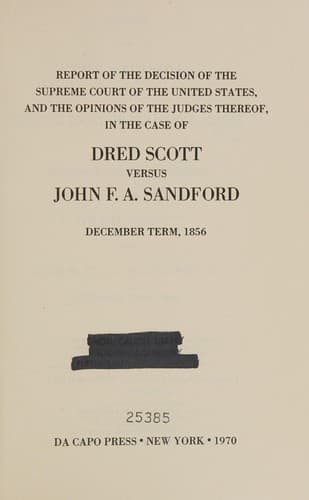
Report of the Decision of the Supreme Court of the United States, and the Opinions of the Judges Thereof, in the Case of Dred Scott versus John F. A. Sandford: December Term, 1856.United States. Supreme Court
History
Report of the Decision of the Supreme Court of the United States, and the Opinions of the Judges Thereof, in the Case of Dred Scott versus John F. A. Sandford: December Term, 1856.
United States. Supreme Court
Scott, Dred, 1809-1858; Slavery -- United States
But the more eminent men of Massachusetts rejected it; and another
patriot of the time employs the instance to warn us of "the stealth
with which oppression approaches," and "the enormities towards which
precedents travel." And the people of the United States, as we have
seen, appealed to the last argument, rather than acquiesce in their
authority. Could it have been the purpose of Washington and his
illustrious associates, by the use of ambiguous, equivocal, and
expansive words, such as "rules," "regulations," "territory," to
re-establish in the Constitution of their country that _fort_ which
had been prostrated amid the toils and with the sufferings and
sacrifices of seven years of war? Are these words to be understood as
the Norths, the Grenvilles, Hillsboroughs, Hutchinsons, and
Dunmores--in a word, as George III would have understood them--or are
we to look for their interpretation to Patrick Henry or Samuel Adams,
to Jefferson, and Jay, and Dickinson; to the sage Franklin, or to
Hamilton, who from his early manhood was engaged in combating British
constructions of such words? We know that the resolution of Congress
of 1780 contemplated that the new States to be formed under their
recommendation were to have the same rights of sovereignty, freedom,
and independence, as the old. That every resolution, cession, compact,
and ordinance, of the States, observed the same liberal principle.
That the Union of the Constitution is a union formed of equal States;
and that new States, when admitted, were to enter "this Union." Had
another union been proposed in "any pointed manner," it would have
encountered not only "strong" but successful opposition. The disunion
between Great Britain and her colonies originated in the antipathy of
the latter to "rules and regulations" made by a remote power
respecting their internal policy. In forming the Constitution, this
fact was ever present in the minds of its authors. The people were
assured by their most trusted statesmen "that the jurisdiction of the
Federal Government is limited to certain enumerated objects, which
concern all members of the republic," and "that the local or municipal
authorities form distinct portions of supremacy, no more subject
within their respective spheres to the general authority, than the
general authority is subject to them within its own sphere." Still,
this did not content them. Under the lead of Hancock and Samuel Adams,
of Patrick Henry and George Mason, they demanded an explicit
declaration that no more power was to be exercised than they had
delegated. And the ninth and tenth amendments to the Constitution were
designed to include the reserved rights of the States, and the people,
within all the sanctions of that instrument, and to bind the
authorities, State and Federal, by the judicial oath it prescribes, to
their recognition and observance. Is it probable, therefore, that the
supreme and irresponsible power, which is now claimed for Congress
Public-domain text, read in full here on John Shaqi.
Reviews
Reviews
No reviews yet
Be the first to share your thoughts on this work.
Elsewhere in the archive
Join the Discussion
Join the discussion
Sign in to leave a comment or review.
Sign InorCreate an account