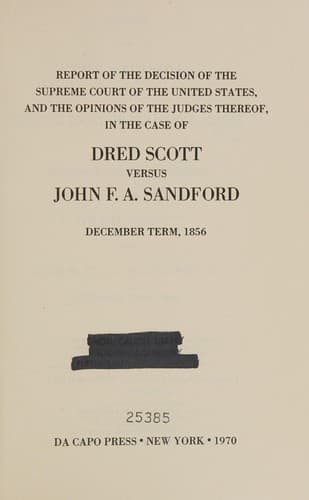
Report of the Decision of the Supreme Court of the United States, and the Opinions of the Judges Thereof, in the Case of Dred Scott versus John F. A. Sandford: December Term, 1856.United States. Supreme Court
History
Report of the Decision of the Supreme Court of the United States, and the Opinions of the Judges Thereof, in the Case of Dred Scott versus John F. A. Sandford: December Term, 1856.
United States. Supreme Court
Scott, Dred, 1809-1858; Slavery -- United States
over boundless territories, the use of which cannot fail to react upon
the political system of the States, to its subversion, was ever within
the contemplation of the statesmen who conducted the counsels of the
people in the formation of this Constitution? When the questions that
came to the surface upon the acquisition of Louisiana were presented
to the mind of Jefferson, he wrote: "I had rather ask an enlargement
of power from the nation, where it is found necessary, than to assume
it by a construction which would make our powers boundless. Our
peculiar security is in the possession of a written Constitution. Let
us not make it blank paper by construction. I say the same as to the
opinion of those who consider the grant of the treaty-making power as
boundless. If it is, then we have no Constitution. If it has bounds,
they can be no others than the definitions of the powers which that
instrument gives. It specifies and delineates the operations permitted
to the Federal Government, and gives the powers necessary to carry
them into execution." The publication of the journals of the Federal
Convention in 1819, of the debates reported by Mr. Madison in 1840,
and the mass of private correspondence of the early statesmen before
and since, enable us to approach the discussion of the aims of those
who made the Constitution, with some insight and confidence.
I have endeavored, with the assistance of these, to find a solution
for the grave and difficult question involved in this inquiry. My
opinion is, that the claim for Congress of supreme power in the
Territories, under the grant to "dispose of and make all needful rules
and regulations respecting _territory_," is not supported by the
historical evidence drawn from the Revolution, the Confederation, or
the deliberations which preceded the ratification of the Federal
Constitution. The ordinance of 1787 depended upon the action of the
Congress of the Confederation, the assent of the State of Virginia,
and the acquiescence of the people who recognised the validity of that
plea of necessity which supported so many of the acts of the
Governments of that time; and the Federal Government accepted the
ordinance as a recognised and valid engagement of the Confederation.
In referring to the precedents of 1798 and 1800, I find the
Constitution was plainly violated by the invasion of the rights of a
sovereign State, both of soil and jurisdiction; and in reference to
that of 1804, the wisest statesmen protested against it, and the
President more than doubted its policy and the power of the
Government.
Public-domain text, read in full here on John Shaqi.
Reviews
Reviews
No reviews yet
Be the first to share your thoughts on this work.
Elsewhere in the archive
Join the Discussion
Join the discussion
Sign in to leave a comment or review.
Sign InorCreate an account