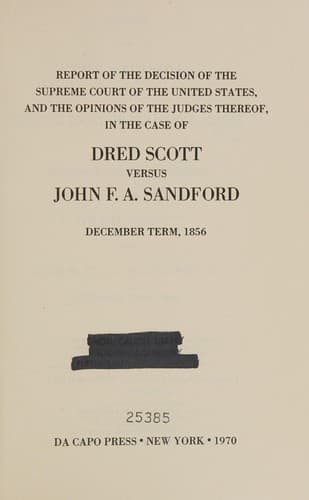
Report of the Decision of the Supreme Court of the United States, and the Opinions of the Judges Thereof, in the Case of Dred Scott versus John F. A. Sandford: December Term, 1856.United States. Supreme Court
History
Report of the Decision of the Supreme Court of the United States, and the Opinions of the Judges Thereof, in the Case of Dred Scott versus John F. A. Sandford: December Term, 1856.
United States. Supreme Court
Scott, Dred, 1809-1858; Slavery -- United States
As this vacant country had been won by the blood and treasure of all
the States, those whose charters did not reach it, insisted that the
country belonged to the States united, and that the lands should be
disposed of for the benefit of the whole; and to which end, the
western territory should be ceded to the States united. The contest
was stringent and angry, long before the Convention convened, and
deeply agitated that body. As a matter of justice, and to quiet the
controversy, Virginia consented to cede the country north of the Ohio
as early as 1783; and in 1784 the deed of cession was executed, by her
delegates in the Congress of the Confederation, conveying to the
United States in Congress assembled, for the benefit of said States,
"all right, title, and claim, as well of soil as of jurisdiction,
which this Commonwealth hath to the _territory_ or tract of country
within the limits of the Virginia charter, situate, lying, and being
to the northwest of the river Ohio." In 1787, (July 13,) the ordinance
was passed by the old Congress to govern the Territory.
Massachusetts had ceded her pretension of claim to western territory
in 1785, Connecticut hers in 1786, and New York had ceded hers. In
August, 1787, South Carolina ceded to the Confederation her pretension
of claim to territory west of that State. And North Carolina was
expected to cede hers, which she did do, in April, 1790. And so
Georgia was confidently expected to cede her large domain, now
constituting the territory of the States of Alabama and Mississippi.
At the time the Constitution was under consideration, there had been
ceded to the United States, or was shortly expected to be ceded, all
the western country, from the British Canada line to Florida, and from
the head of the Mississippi almost to its mouth, except that portion
which now constitutes the State of Kentucky.
Although Virginia had conferred on the Congress of the Confederation
power to govern the Territory north of the Ohio, still, it cannot be
denied, as I think, that power was wanting to admit a new State under
the Articles of Confederation.
With these facts prominently before the Convention, they proposed to
accomplish these ends:
1st. To give power to admit new States.
2d. To dispose of the public lands in the Territories, and such as
might remain undisposed of in the new States after they were admitted.
And, thirdly, to give power to govern the different Territories as
incipient States, not of the Union, and fit them for admission. No one
in the Convention seems to have doubted that these powers were
necessary. As early as the third day of its session, (May 29th,)
Edmund Randolph brought forward a set of resolutions containing nearly
all the germs of the Constitution, the tenth of which is as follows:
Public-domain text, read in full here on John Shaqi.
Reviews
Reviews
No reviews yet
Be the first to share your thoughts on this work.
Elsewhere in the archive
Join the Discussion
Join the discussion
Sign in to leave a comment or review.
Sign InorCreate an account