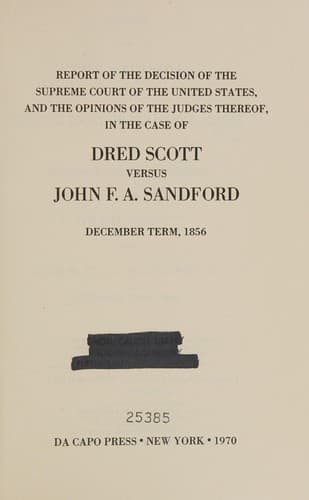
Report of the Decision of the Supreme Court of the United States, and the Opinions of the Judges Thereof, in the Case of Dred Scott versus John F. A. Sandford: December Term, 1856.United States. Supreme Court
History
Report of the Decision of the Supreme Court of the United States, and the Opinions of the Judges Thereof, in the Case of Dred Scott versus John F. A. Sandford: December Term, 1856.
United States. Supreme Court
Scott, Dred, 1809-1858; Slavery -- United States
"_Resolved_, That provision ought to be made for the admission of
States lawfully arising within the limits of the United States,
whether from a voluntary junction of government and territory or
otherwise, with the consent of a number of voices in the National
Legislature less than the whole."
August 18th, Mr. Madison submitted, in order to be referred to the
committee of detail, the following powers as proper to be added to
those of the General Legislature:
"To dispose of the unappropriated lands of the United States." "To
institute temporary Governments for new States arising therein." (3
Madison Papers, 1353.)
These, with the resolution, that a district for the location of the
seat of Government should be provided, and some others, were referred,
without a dissent, to the committee of detail, to arrange and put them
into satisfactory language.
Gouverneur Morris constructed the clauses, and combined the views of a
majority on the two provisions, to admit new States; and secondly, to
dispose of the public lands, and to govern the Territories, in the
mean time, between the cessions of the States and the admission into
the Union of new States arising in the ceded territory. (3 Madison
Papers, 1456 to 1466.)
It was hardly possible to separate the power "to make all needful
rules and regulations" respecting the government of the territory and
the disposition of the public lands.
North of the Ohio, Virginia conveyed the lands, and vested the
jurisdiction in the thirteen original States, before the Constitution
was formed. She had the sole title and sole sovereignty, and the same
power to cede, on any terms she saw proper, that the King of England
had to grant the Virginia colonial charter of 1609, or to grant the
charter of Pennsylvania to William Penn. The thirteen States, through
their representatives and deputed ministers in the old Congress, had
the same right to govern that Virginia had before the cession.
(Baldwin's Constitutional Views, 90.) And the sixth article of the
Constitution adopted all engagements entered into by the Congress of
the Confederation, as valid against the United States; and that the
laws, made in pursuance of the new Constitution, to carry out this
engagement, should be the supreme law of the land, and the judges
bound thereby. To give the compact, and the ordinance, which was part
of it, full effect under the new Government, the act of August 7th,
1789, was passed, which declares, "Whereas, in order that the
ordinance of the United States in Congress assembled, for the
government of the Territory northwest of the river Ohio, may have full
effect, it is requisite that certain provisions should be made, so as
to adapt the same to the present Constitution of the United States."
It is then provided that the Governor and other officers should be
appointed by the President, with the consent of the Senate; and be
subject to removal, &c., in like manner that they were by the old
Congress, whose functions had ceased.
Public-domain text, read in full here on John Shaqi.
Reviews
Reviews
No reviews yet
Be the first to share your thoughts on this work.
Elsewhere in the archive
Join the Discussion
Join the discussion
Sign in to leave a comment or review.
Sign InorCreate an account