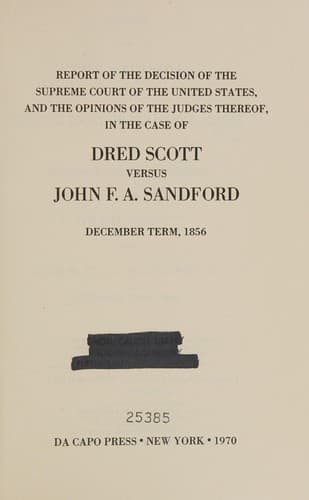
Report of the Decision of the Supreme Court of the United States, and the Opinions of the Judges Thereof, in the Case of Dred Scott versus John F. A. Sandford: December Term, 1856.United States. Supreme Court
History
Report of the Decision of the Supreme Court of the United States, and the Opinions of the Judges Thereof, in the Case of Dred Scott versus John F. A. Sandford: December Term, 1856.
United States. Supreme Court
Scott, Dred, 1809-1858; Slavery -- United States
By the powers to govern, given by the Constitution, those amendments
to the ordinance could be made, but Congress guardedly abstained from
touching the compact of Virginia, further than to adapt it to the new
Constitution.
It is due to myself to say, that it is asking much of a judge, who
has for nearly twenty years been exercising jurisdiction, from the
western Missouri line to the Rocky Mountains, and, on this
understanding of the Constitution, inflicting the extreme penalty of
death for crimes committed where the direct legislation of Congress
was the only rule, to agree that he had been all the while acting in
mistake, and as an usurper.
More than sixty years have passed away since Congress has exercised
power to govern the Territories, by its legislation directly, or by
Territorial charters, subject to repeal at all times, and it is now
too late to call that power into question, if this court could
disregard its own decisions; which it cannot do, as I think. It was
held in the case of Cross _v._ Harrison, (16 How., 193-'4,) that the
sovereignty of California was in the United States, in virtue of the
Constitution, by which power had been given to Congress to dispose of
and make all needful rules and regulations respecting the territory or
other property belonging to the United States, with the power to admit
new States into the Union. That decision followed preceding ones,
there cited. The question was then presented, how it was possible for
the judicial mind to conceive that the United States Government,
created solely by the Constitution, could, by a lawful treaty, acquire
territory over which the acquiring power had no jurisdiction to hold
and govern it, by force of the instrument under whose authority the
country was acquired; and the foregoing was the conclusion of this
court on the proposition. What was there announced, was most
deliberately done, and with a purpose. The only question here is, as I
think, how far the power of Congress is limited.
As to the Northwest Territory, Virginia had the right to abolish
slavery there; and she did so agree in 1787, with the other States in
the Congress of the Confederation, by assenting to and adopting the
ordinance of 1787, for the government of the Northwest Territory. She
did this also by an act of her Legislature, passed afterwards, which
was a treaty in fact.
Before the new Constitution was adopted, she had as much right to
treat and agree as any European Government had. And, having excluded
slavery, the new Government was bound by that engagement by article
six of the new Constitution. This only meant that slavery should not
exist whilst the United States exercised the power of government, in
the Territorial form; for, when a new State came in, it might do so,
with or without slavery.
Public-domain text, read in full here on John Shaqi.
Reviews
Reviews
No reviews yet
Be the first to share your thoughts on this work.
Elsewhere in the archive
Join the Discussion
Join the discussion
Sign in to leave a comment or review.
Sign InorCreate an account