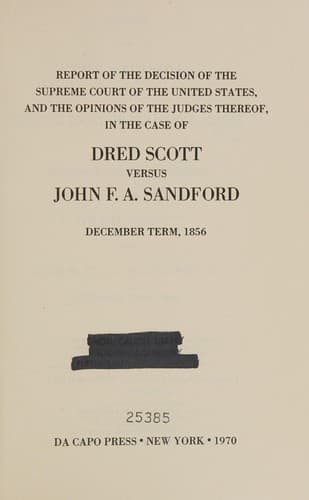
Report of the Decision of the Supreme Court of the United States, and the Opinions of the Judges Thereof, in the Case of Dred Scott versus John F. A. Sandford: December Term, 1856.United States. Supreme Court
History
Report of the Decision of the Supreme Court of the United States, and the Opinions of the Judges Thereof, in the Case of Dred Scott versus John F. A. Sandford: December Term, 1856.
United States. Supreme Court
Scott, Dred, 1809-1858; Slavery -- United States
My opinion is, that Congress had no power, in face of the compact
between Virginia and the twelve other States, to _force_ slavery into
the Northwest Territory, because there, it was bound to that
"engagement," and could not break it.
In 1790, North Carolina ceded her western territory, now the State of
Tennessee, and stipulated that the inhabitants thereof should enjoy
all the privileges and advantages of the ordinance for governing the
territory north of the Ohio river, and that Congress should assume the
government, and accept the cession, under the express conditions
contained in the ordinance: _Provided_, "That no regulation made, or
to be made, by Congress, shall tend to emancipate slaves."
In 1802, Georgia ceded her western territory to the United States,
with the provision that the ordinance of 1787 should in all its parts
extend to the territory ceded, "that article only excepted which
forbids slavery." Congress had no more power to legislate slavery
_out_ from the North Carolina and Georgia cessions, than it had power
to legislate slavery in, north of the Ohio. No power existed in
Congress to legislate at all, affecting slavery, in either case. The
inhabitants, as respected this description of property, stood
protected whilst they were governed by Congress, in like manner that
they were protected before the cession was made, and when they were,
respectively, parts of North Carolina and Georgia.
And how does the power of Congress stand west of the Mississippi
river? The country there was acquired from France, by treaty, in 1803.
It declares, that the First Consul, in the name of the French
Republic, doth hereby cede to the United States, in full sovereignty,
the colony or province of Louisiana, with all the rights and
appurtenances of the said territory. And, by article third, that "the
inhabitants of the ceded territory shall be incorporated in the Union
of the United States, and admitted as soon as possible, according to
the principles of the Federal Constitution, to the enjoyment of all
the rights, advantages, and immunities, of citizens of the United
States; and, in the mean time, they shall be maintained and protected
in the free enjoyment of their liberty, property, and the religion
which they profess."
Public-domain text, read in full here on John Shaqi.
Reviews
Reviews
No reviews yet
Be the first to share your thoughts on this work.
Elsewhere in the archive
Join the Discussion
Join the discussion
Sign in to leave a comment or review.
Sign InorCreate an account