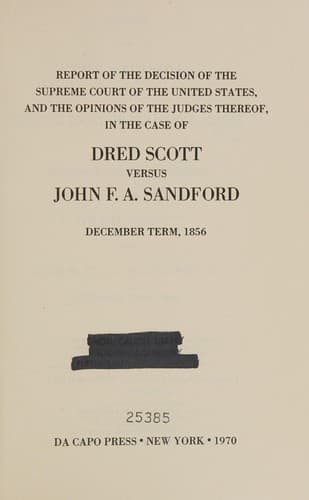
Report of the Decision of the Supreme Court of the United States, and the Opinions of the Judges Thereof, in the Case of Dred Scott versus John F. A. Sandford: December Term, 1856.United States. Supreme Court
History
Report of the Decision of the Supreme Court of the United States, and the Opinions of the Judges Thereof, in the Case of Dred Scott versus John F. A. Sandford: December Term, 1856.
United States. Supreme Court
Scott, Dred, 1809-1858; Slavery -- United States
But, if it be admitted that the word territory as used means land, and
nothing but land, the power of Congress to organize a temporary
Government is clear. It has power to make all needful regulations
respecting the public lands, and the extent of those "needful
regulations" depends upon the direction of Congress, where the means
are appropriate to the end, and do not conflict with any of the
prohibitions of the Constitution. If a temporary Government be deemed
needful, necessary, requisite, or is wanted, Congress has power to
establish it. This court says, in McCulloch _v._ The State of
Maryland, (4 Wheat., 316,) "If a certain means to carry into effect
any of the powers expressly given by the Constitution to the
Government of the Union be an appropriate measure, not prohibited by
the Constitution, the degree of its necessity is a question of
legislative discretion, not of judicial cognizance."
The power to establish post offices and post roads gives power to
Congress to make contracts for the transportation of the mail, and to
punish all who commit depredations upon it in its transit, or at its
places of distribution. Congress has power to regulate commerce, and,
in the exercise of its discretion, to lay an embargo, which suspends
commerce; so, under the same power, harbors, lighthouses, breakwaters,
&c., are constructed.
Did Chief Justice Marshall, in saying that Congress governed a
Territory, by exercising the combined powers of the Federal and State
Governments, refer to unlimited discretion? A Government which can
make white men slaves? Surely, such a remark in the argument must have
been inadvertently uttered. On the contrary, there is no power in the
Constitution by which Congress can make either white or black men
slaves. In organizing the Government of a Territory, Congress is
limited to means appropriate to the attainment of the constitutional
object. No powers can be exercised which are prohibited by the
Constitution, or which are contrary to its spirit; so that, whether
the object may be the protection of the persons and property of
purchasers of the public lands, or of communities who have been
annexed to the Union by conquest or purchase, they are initiatory to
the establishment of State Governments, and no more power can be
claimed or exercised than is necessary to the attainment of the end.
This is the limitation of all the Federal powers.
But Congress has no power to regulate the internal concerns of a
State, as of a Territory; consequently, in providing for the
Government of a Territory, to some extent, the combined powers of the
Federal and State Governments are necessarily exercised.
Public-domain text, read in full here on John Shaqi.
Reviews
Reviews
No reviews yet
Be the first to share your thoughts on this work.
Elsewhere in the archive
Join the Discussion
Join the discussion
Sign in to leave a comment or review.
Sign InorCreate an account