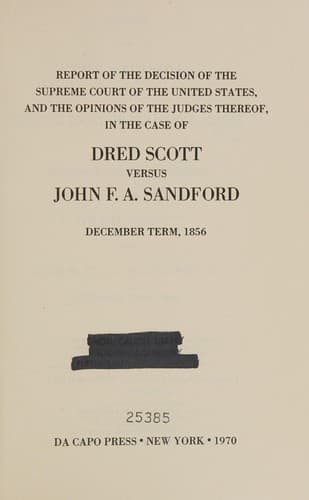
Report of the Decision of the Supreme Court of the United States, and the Opinions of the Judges Thereof, in the Case of Dred Scott versus John F. A. Sandford: December Term, 1856.United States. Supreme Court
History
Report of the Decision of the Supreme Court of the United States, and the Opinions of the Judges Thereof, in the Case of Dred Scott versus John F. A. Sandford: December Term, 1856.
United States. Supreme Court
Scott, Dred, 1809-1858; Slavery -- United States
If Congress should deem slaves or free colored persons injurious to
the population of a free Territory, as conducing to lessen the value
of the public lands, or on any other ground connected with the public
interest, they have the power to prohibit them from becoming settlers
in it. This can be sustained on the ground of a sound national policy,
which is so clearly shown in our history by practical results, that it
would seem no considerate individual can question it. And, as regards
any unfairness of such a policy to our Southern brethren, as urged in
the argument, it is only necessary to say that, with one-fourth of the
Federal population of the Union, they have in the slave States a
larger extent of fertile territory than is included in the free
States; and it is submitted, if masters of slaves be restricted from
bringing them into free territory, that the restriction on the free
citizens of non-slaveholding States, by bringing slaves into free
territory, is four times greater than that complained of by the South.
But, not only so; some three or four hundred thousand holders of
slaves, by bringing them into free territory, impose a restriction on
twenty millions of the free States. The repugnancy to slavery would
probably prevent fifty or a hundred freemen from settling in a slave
Territory, where one slaveholder would be prevented from settling in a
free Territory.
This remark is made in answer to the argument urged, that a
prohibition of slavery in the free Territories is inconsistent with
the continuance of the Union. Where a Territorial Government is
established in a slave Territory, it has uniformly remained in that
condition until the people form a State Constitution; the same course
where the Territory is free, both parties acting in good faith, would
be attended with satisfactory results.
The sovereignty of the Federal Government extends to the entire limits
of our territory. Should any foreign power invade our jurisdiction, it
would be repelled. There is a law of Congress to punish our citizens
for crimes committed in districts of country where there is no
organized Government. Criminals are brought to certain Territories or
States, designated in the law, for punishment. Death has been
inflicted in Arkansas and in Missouri, on individuals, for murders
committed beyond the limit of any organized Territory or State; and no
one doubts that such a jurisdiction was rightfully exercised. If there
be a right to acquire territory, there necessarily must be an implied
power to govern it. When the military force of the Union shall conquer
a country, may not Congress provide for the government of such
country? This would be an implied power essential to the acquisition
of new territory. This power has been exercised, without doubt of its
constitutionality, over territory acquired by conquest and purchase.
Public-domain text, read in full here on John Shaqi.
Reviews
Reviews
No reviews yet
Be the first to share your thoughts on this work.
Elsewhere in the archive
Join the Discussion
Join the discussion
Sign in to leave a comment or review.
Sign InorCreate an account