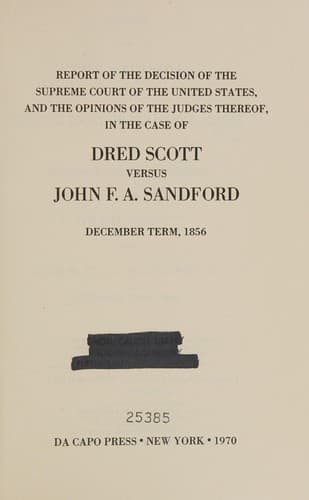
Report of the Decision of the Supreme Court of the United States, and the Opinions of the Judges Thereof, in the Case of Dred Scott versus John F. A. Sandford: December Term, 1856. — John Shaqi
Report of the Decision of the Supreme Court of the United States, and the Opinions of the Judges Thereof, in the Case of Dred Scott versus John F. A. Sandford: December Term, 1856.United States. Supreme Court
History
Report of the Decision of the Supreme Court of the United States, and the Opinions of the Judges Thereof, in the Case of Dred Scott versus John F. A. Sandford: December Term, 1856.
United States. Supreme Court
Scott, Dred, 1809-1858; Slavery -- United States
The general words above quoted would seem to embrace the whole human
family, and if they were used in a similar instrument at this day
would be so understood. But it is too clear for dispute, that the
enslaved African race were not intended to be included, and formed no
part of the people who framed and adopted this declaration; for if the
language, as understood in that day, would embrace them, the conduct
of the distinguished men who framed the Declaration of Independence
would have been utterly and flagrantly inconsistent with the
principles they asserted; and instead of the sympathy of mankind, to
which they so confidently appealed, they would have deserved and
received universal rebuke and reprobation.
Yet the men who framed this declaration were great men--high in
literary acquirements--high in their sense of honor, and incapable of
asserting principles inconsistent with those on which they were
acting. They perfectly understood the meaning of the language they
used, and how it would be understood by others; and they knew that it
would not in any part of the civilized world be supposed to embrace
the negro race, which, by common consent, had been excluded from
civilized Governments and the family of nations, and doomed to
slavery. They spoke and acted according to the then established
doctrines and principles, and in the ordinary language of the day, and
no one misunderstood them. The unhappy black race were separated from
the white by indelible marks, and laws long before established, and
were never thought of or spoken of except as property, and when the
claims of the owner or the profit of the trader were supposed to need
protection.
This state of public opinion had undergone no change when the
Constitution was adopted, as is equally evident from its provisions
and language.
The brief preamble sets forth by whom it was formed, for what
purposes, and for whose benefit and protection. It declares that it
is formed by the _people_ of the United States; that is to say, by
those who were members of the different political communities in the
several States; and its great object is declared to be to secure the
blessings of liberty to themselves and their posterity. It speaks in
general terms of the _people_ of the United States, and of _citizens_
of the several States, when it is providing for the exercise of the
powers granted or the privileges secured to the citizen. It does not
define what description of persons are intended to be included under
these terms, or who shall be regarded as a citizen and one of the
people. It uses them as terms so well understood, that no further
description or definition was necessary.
But there are two clauses in the Constitution which point directly and
specifically to the negro race as a separate class of persons, and
show clearly that they were not regarded as a portion of the people or
citizens of the Government then formed.
Public-domain text, read in full here on John Shaqi.
Reviews
Reviews
No reviews yet
Be the first to share your thoughts on this work.
Join the Discussion
Join the discussion
Sign in to leave a comment or review.
Sign InorCreate an account