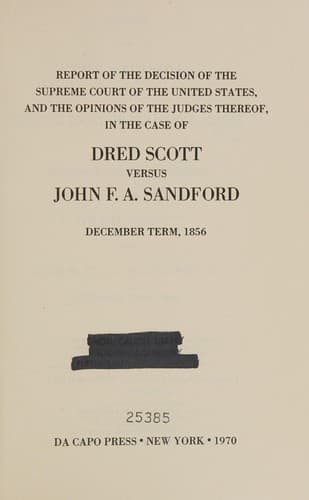
Report of the Decision of the Supreme Court of the United States, and the Opinions of the Judges Thereof, in the Case of Dred Scott versus John F. A. Sandford: December Term, 1856.United States. Supreme Court
History
Report of the Decision of the Supreme Court of the United States, and the Opinions of the Judges Thereof, in the Case of Dred Scott versus John F. A. Sandford: December Term, 1856.
United States. Supreme Court
Scott, Dred, 1809-1858; Slavery -- United States
One of these clauses reserves to each of the thirteen States the right
to import slaves until the year 1808, if it thinks proper. And the
importation which it thus sanctions was unquestionably of persons of
the race of which we are speaking, as the traffic in slaves in the
United States had always been confined to them. And by the other
provision the States pledge themselves to each other to maintain the
right of property of the master, by delivering up to him any slave who
may have escaped from his service, and be found within their
respective territories. By the first above-mentioned clause,
therefore, the right to purchase and hold this property is directly
sanctioned and authorized for twenty years by the people who framed
the Constitution. And by the second, they pledge themselves to
maintain and uphold the right of the master in the manner specified,
as long as the Government they then formed should endure. And these
two provisions show, conclusively, that neither the description of
persons therein referred to, nor their descendants, were embraced in
any of the other provisions of the Constitution; for certainly these
two clauses were not intended to confer on them or their posterity the
blessings of liberty, or any of the personal rights so carefully
provided for the citizen.
No one of that race had ever migrated to the United States
voluntarily; all of them had been brought here as articles of
merchandise. The number that had been emancipated at that time were
but few in comparison with those held in slavery; and they were
identified in the public mind with the race to which they belonged,
and regarded as a part of the slave population rather than the free.
It is obvious that they were not even in the minds of the framers of
the Constitution when they were conferring special rights and
privileges upon the citizens of a State in every other part of the
Union.
Indeed, when we look to the condition of this race in the several
States at the time, it is impossible to believe that these rights and
privileges were intended to be extended to them.
Public-domain text, read in full here on John Shaqi.
Reviews
Reviews
No reviews yet
Be the first to share your thoughts on this work.
Join the Discussion
Join the discussion
Sign in to leave a comment or review.
Sign InorCreate an account