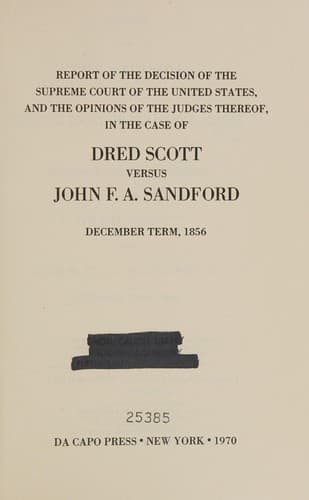
Report of the Decision of the Supreme Court of the United States, and the Opinions of the Judges Thereof, in the Case of Dred Scott versus John F. A. Sandford: December Term, 1856.United States. Supreme Court
History
Report of the Decision of the Supreme Court of the United States, and the Opinions of the Judges Thereof, in the Case of Dred Scott versus John F. A. Sandford: December Term, 1856.
United States. Supreme Court
Scott, Dred, 1809-1858; Slavery -- United States
In Julia _v._ McKinney, (3 Missouri Rep., 279,) it was held, where a
slave was settled in the State of Illinois, but with an intention on
the part of the owner to be removed at some future day, that hiring
said slave to a person to labor for one or two days, and receiving the
pay for the hire, the slave is entitled to her freedom, under the
second section of the sixth article of the Constitution of Illinois.
Rachel _v._ Walker (4 Missouri Rep., 350, June term, 1836) is a case
involving, in every particular, the principles of the case before us.
Rachel sued for her freedom; and it appeared that she had been bought
as a slave in Missouri, by Stockton, an officer of the army, taken to
Fort Snelling, where he was stationed, and she was retained there as a
slave a year; and then Stockton removed to Prairie du Chien, taking
Rachel with him as a slave, where he continued to hold her three
years, and then he took her to the State of Missouri, and sold her as
a slave.
"Fort Snelling was admitted to be on the west side of the Mississippi
river, and north of the State of Missouri, in the territory of the
United States. That Prairie du Chien was in the Michigan Territory, on
the east side of the Mississippi river. Walker, the defendant, held
Rachel under Stockton."
The court said, in this case:
"The officer lived in Missouri Territory, at the time he bought the
slave; he sent to a slaveholding country and procured her; this was
his voluntary act, done without any other reason than that of his
convenience; and he and those claiming under him must be holden to
abide the consequences of introducing slavery both in Missouri
Territory and Michigan, contrary to law; and on that ground Rachel was
declared to be entitled to freedom."
In answer to the argument that, as an officer of the army, the master
had a right to take his slave into free territory, the court said no
authority of law or the Government compelled him to keep the plaintiff
there as a slave.
"Shall it be said, that because an officer of the army owns slaves in
Virginia, that when, as officer and soldier, he is required to take
the command of a fort in the non-slaveholding States or Territories,
he thereby has a right to take with him as many slaves as will suit
his interests or convenience? It surely cannot be law. If this be
true, the court say, then it is also true that the convenience or
supposed convenience of the officer repeals, as to him and others who
have the same character, the ordinance and the act of 1821, admitting
Missouri into the Union, and also the prohibition of the several laws
and Constitutions of the non-slaveholding States."
Public-domain text, read in full here on John Shaqi.
Reviews
Reviews
No reviews yet
Be the first to share your thoughts on this work.
Elsewhere in the archive
Join the Discussion
Join the discussion
Sign in to leave a comment or review.
Sign InorCreate an account