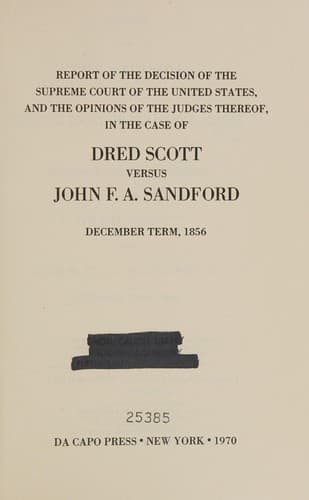
Report of the Decision of the Supreme Court of the United States, and the Opinions of the Judges Thereof, in the Case of Dred Scott versus John F. A. Sandford: December Term, 1856.United States. Supreme Court
History
Report of the Decision of the Supreme Court of the United States, and the Opinions of the Judges Thereof, in the Case of Dred Scott versus John F. A. Sandford: December Term, 1856.
United States. Supreme Court
Scott, Dred, 1809-1858; Slavery -- United States
In Wilson _v._ Melvin, (4 Missouri R., 592,) it appeared the defendant
left Tennessee with an intention of residing in Illinois, taking his
negroes with him. After a month's stay in Illinois, he took his
negroes to St. Louis, and hired them, then returned to Illinois. On
these facts, the inferior court instructed the jury that the defendant
was a sojourner in Illinois. This the Supreme Court held was error,
and the judgment was reversed.
The case of Dred Scott _v._ Emerson (15 Missouri R., 682, March term,
1852) will now be stated. This case involved the identical question
before us, Emerson having, since the hearing, sold the plaintiff to
Sandford, the defendant.
Two of the judges ruled the case, the Chief Justice dissenting. It
cannot be improper to state the grounds of the opinion of the court,
and of the dissent.
The court say: "Cases of this kind are not strangers in our court.
Persons have been frequently here adjudged to be entitled to their
freedom, on the ground that their masters held them in slavery in
Territories or States in which that institution is prohibited. From
the first case decided in our court, it might be inferred that this
result was brought about by a presumed assent of the master, from the
fact of having voluntarily taken his slave to a place where the
relation of master and slave did not exist. But subsequent cases base
the right to 'exact the forfeiture of emancipation,' as they term it,
on the ground, it would seem, that it was the duty of the courts of
this State to carry into effect the Constitution and laws of other
States and Territories, regardless of the rights, the policy, or the
institutions, of the people of this State."
And the court say that the States of the Union, in their municipal
concerns, are regarded as foreign to each other; that the courts of
one State do not take notice of the laws of other States, unless
proved as facts, and that every State has the right to determine how
far its comity to other States shall extend; and it is laid down, that
when there is no act of manumission decreed to the free State, the
courts of the slave States cannot be called to give effect to the law
of the free State. Comity, it alleges, between States, depends upon
the discretion of both, which may be varied by circumstances. And it
is declared by the court, "that times are not as they were when the
former decisions on this subject were made." Since then, not only
individuals but States have been possessed with a dark and fell spirit
in relation to slavery, whose gratification is sought in the pursuit
of measures whose inevitable consequence must be the overthrow and
destruction of our Government. Under such circumstances, it does not
behoove the State of Missouri to show the least countenance to any
measure which might gratify this spirit. She is willing to assume her
full responsibility for the existence of slavery within her limits,
nor does she seek to share or divide it with others.
Public-domain text, read in full here on John Shaqi.
Reviews
Reviews
No reviews yet
Be the first to share your thoughts on this work.
Elsewhere in the archive
Join the Discussion
Join the discussion
Sign in to leave a comment or review.
Sign InorCreate an account