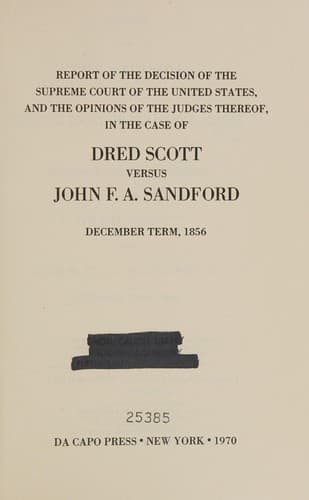
Report of the Decision of the Supreme Court of the United States, and the Opinions of the Judges Thereof, in the Case of Dred Scott versus John F. A. Sandford: December Term, 1856.United States. Supreme Court
History
Report of the Decision of the Supreme Court of the United States, and the Opinions of the Judges Thereof, in the Case of Dred Scott versus John F. A. Sandford: December Term, 1856.
United States. Supreme Court
Scott, Dred, 1809-1858; Slavery -- United States
Chief Justice Gamble dissented from the other two judges. He says:
"In every slaveholding State in the Union, the subject of emancipation
is regulated by statute; and the forms are prescribed in which it
shall be effected. Whenever the forms required by the laws of the
State in which the master and slave are resident are complied with,
the emancipation is complete, and the slave is free. If the right of
the person thus emancipated is subsequently drawn in question in
another State, it will be ascertained and determined by the law of the
State in which the slave and his former master resided; and when it
appears that such law has been complied with, the right to freedom
will be fully sustained in the courts of all the slaveholding States,
although the act of emancipation may not be in the form required by
law in which the court sits.
"In all such cases, courts continually administer the law of the
country where the right was acquired; and when that law becomes known
to the court, it is just as much a matter of course to decide the
rights of the parties according to its requirements, as it is to
settle the title of real estate situated in our State by its own
laws."
This appears to me a most satisfactory answer to the argument of the
court. Chief Justice continues:
"The perfect equality of the different States lies at the foundation
of the Union. As the institution of slavery in the States is one over
which the Constitution of the United States gives no power to the
General Government, it is left to be adopted or rejected by the
several States, as they think best; nor can any one State, or number
of States, claim the right to interfere with any other State upon the
question of admitting or excluding this institution.
"A citizen of Missouri, who removes with his slave to Illinois, has
no right to complain that the fundamental law of that State to which
he removes, and in which he makes his residence, dissolves the
relation between him and his slave. It is as much his own voluntary
act, as if he had executed a deed of emancipation. No one can pretend
ignorance of this constitutional provision, and," he says, "the
decisions which have heretofore been made in this State, and in many
other slaveholding States, give effect to this and other similar
provisions, on the ground that the master, by making the free State
the residence of his slave, has submitted his right to the operation
of the law of such State; and this," he says, "is the same in law as a
regular deed of emancipation."
He adds:
Public-domain text, read in full here on John Shaqi.
Reviews
Reviews
No reviews yet
Be the first to share your thoughts on this work.
Elsewhere in the archive
Join the Discussion
Join the discussion
Sign in to leave a comment or review.
Sign InorCreate an account