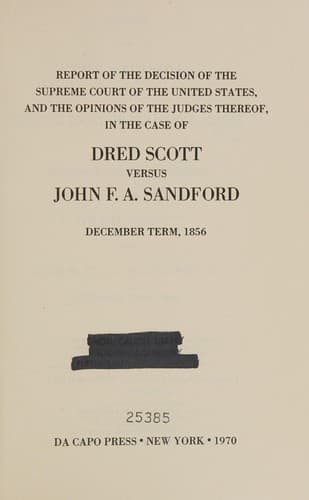
Report of the Decision of the Supreme Court of the United States, and the Opinions of the Judges Thereof, in the Case of Dred Scott versus John F. A. Sandford: December Term, 1856.United States. Supreme Court
History
Report of the Decision of the Supreme Court of the United States, and the Opinions of the Judges Thereof, in the Case of Dred Scott versus John F. A. Sandford: December Term, 1856.
United States. Supreme Court
Scott, Dred, 1809-1858; Slavery -- United States
"I regard the question as conclusively settled by repeated
adjudications of this court, and, if I doubted or denied the propriety
of those decisions, I would not feel myself any more at liberty to
overturn them, than I would any other series of decisions by which the
law of any other question was settled. There is with me," he says,
"nothing in the law relating to slavery which distinguishes it from
the law on any other subject, or allows any more accommodation to the
temporary public excitements which are gathered around it."
"In this State," he says, "it has been recognised from the beginning
of the Government as a correct position in law, that a master who
takes his slave to reside in a State or Territory where slavery is
prohibited, thereby emancipates his slave." These decisions, which
come down to the year 1837, seemed to have so fully settled the
question, that since that time there has been no case bringing it
before the court for any reconsideration, until the present. In the
case of Winny _v._ Whitesides, the question was made in the argument,
"whether one nation would execute the penal laws of another," and the
court replied in this language, (Huberus, quoted in 4 Dallas,) which
says, "personal rights or disabilities obtained or communicated by the
laws of any particular place are of a nature which accompany the
person wherever he goes;" and the Chief Justice observed, in the case
of Rachel _v._ Walker, the act of Congress called the Missouri
compromise was held as operative as the ordinance of 1787.
When Dred Scott, his wife and children, were removed from Fort
Snelling to Missouri, in 1838, they were free, as the law was then
settled, and continued for fourteen years afterwards, up to 1852, when
the above decision was made. Prior to this, for nearly thirty years,
as Chief Justice Gamble declares, the residence of a master with his
slave in the State of Illinois, or in the Territory north of Missouri,
where slavery was prohibited by the act called the Missouri
compromise, would manumit the slave as effectually as if he had
executed a deed of emancipation; and that an officer of the army who
takes his slave into that State or Territory, and holds him there as a
slave, liberates him the same as any other citizen--and down to the
above time it was settled by numerous and uniform decisions; and that
on the return of the slave to Missouri, his former condition of
slavery did not attach. Such was the settled law of Missouri until the
decision of Scott and Emerson.
In the case of Sylvia _v._ Kirby, (17 Misso. Rep., 434,) the court
followed the above decision, observing it was similar in all respects
to the case of Scott and Emerson.
Public-domain text, read in full here on John Shaqi.
Reviews
Reviews
No reviews yet
Be the first to share your thoughts on this work.
Elsewhere in the archive
Join the Discussion
Join the discussion
Sign in to leave a comment or review.
Sign InorCreate an account