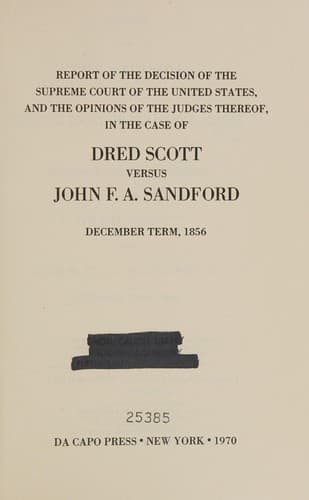
Report of the Decision of the Supreme Court of the United States, and the Opinions of the Judges Thereof, in the Case of Dred Scott versus John F. A. Sandford: December Term, 1856.United States. Supreme Court
History
Report of the Decision of the Supreme Court of the United States, and the Opinions of the Judges Thereof, in the Case of Dred Scott versus John F. A. Sandford: December Term, 1856.
United States. Supreme Court
Scott, Dred, 1809-1858; Slavery -- United States
This court follows the established construction of the statutes of a
State by its Supreme Court. Such a construction is considered as a
part of the statute, and we follow it to avoid two rules of property
in the same State. But we do not follow the decisions of the Supreme
Court of a State beyond a statutory construction as a rule of decision
for this court. State decisions are always viewed with respect and
treated as authority; but we follow the settled construction of the
statutes, not because it is of binding authority, but in pursuance of
a rule of judicial policy.
But there is no pretence that the case of Dred Scott _v._ Emerson
turned upon the construction of a Missouri statute; nor was there any
established rule of property which could have rightfully influenced
the decision. On the contrary, the decision overruled the settled law
for near thirty years.
This is said by my brethren to be a Missouri question; but there is
nothing which gives it this character, except that it involves the
right to persons claimed as slaves who reside in Missouri, and the
decision was made by the Supreme Court of that State. It involves a
right claimed under an act of Congress and the Constitution of
Illinois, and which cannot be decided without the consideration and
construction of those laws. But the Supreme Court of Missouri held, in
this case, that it will not regard either of those laws, without which
there was no case before it; and Dred Scott, having been a slave,
remains a slave. In this respect it is admitted this is a Missouri
question--a case which has but one side, if the act of Congress and
the Constitution of Illinois are not recognised.
And does such a case constitute a rule of decision for this court--a
case to be followed by this court? The course of decision so long and
so uniformly maintained established a comity or law between Missouri
and the free States and Territories where slavery was prohibited,
which must be somewhat regarded in this case. Rights sanctioned for
twenty-eight years ought not and cannot be repudiated, with any
semblance of justice, by one or two decisions, influenced, as
declared, by a determination to counteract the excitement against
slavery in the free States.
Public-domain text, read in full here on John Shaqi.
Reviews
Reviews
No reviews yet
Be the first to share your thoughts on this work.
Elsewhere in the archive
Join the Discussion
Join the discussion
Sign in to leave a comment or review.
Sign InorCreate an account