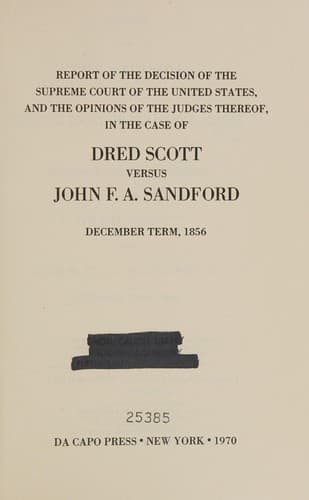
Report of the Decision of the Supreme Court of the United States, and the Opinions of the Judges Thereof, in the Case of Dred Scott versus John F. A. Sandford: December Term, 1856.United States. Supreme Court
History
Report of the Decision of the Supreme Court of the United States, and the Opinions of the Judges Thereof, in the Case of Dred Scott versus John F. A. Sandford: December Term, 1856.
United States. Supreme Court
Scott, Dred, 1809-1858; Slavery -- United States
The case of Rhodes _v._ Bell (2 Howard, 307; 15 Curtis, 152) involved
the main principle in the case before us. A person residing in
Washington city purchased a slave in Alexandria, and brought him to
Washington. Washington continued under the law of Maryland, Alexandria
under the law of Virginia. The act of Maryland of November, 1796, (2
Maxcy's Laws, 351,) declared any one who shall bring any negro,
mulatto or other slave, into Maryland, such slave should be free. The
above slave, by reason of his being brought into Washington city, was
declared by this court to be free. This, it appears to me, is a much
stronger case against the slave than the facts in the case of Scott.
In Bush _v._ White, (3 Monroe, 104,) the court say:
"That the ordinance was paramount to the Territorial laws, and
restrained the legislative power there as effectually as a
Constitution in an organized State. It was a public act of the
Legislature of the Union, and a part of the supreme law of the land;
and, as such, this court is as much bound to take notice of it as it
can be of any other law."
In the case of Rankin _v._ Lydia, before cited, Judge Mills, speaking
for the Court of Appeals of Kentucky, says:
"If, by the positive provision in our code, we can and must hold our
slaves in the one case, and statutory provisions equally positive
decide against that right in the other, and liberate the slave, he
must, by an authority equally imperious, be declared free. Every
argument which supports the right of the master on one side, based
upon the force of written law, must be equally conclusive in favor of
the slave, when he can point out in the statute the clause which
secures his freedom."
And he further said:
"Free people of color in all the States are, it is believed, quasi
citizens, or, at least, denizens. Although none of the States may
allow them the privilege of office and suffrage, yet all other civil
and conventional rights are secured to them; at least, such rights
were evidently secured to them by the ordinance in question for the
government of Indiana. If these rights are vested in that or any other
portion of the United States, can it be compatible with the spirit of
our confederated Government to deny their existence in any other part?
Is there less comity existing between State and State, or State and
Territory, than exists between the despotic Governments of Europe?"
These are the words of a learned and great judge, born and educated in
a slave State.
I now come to inquire, under the sixth and last head, "whether the
decisions of the Supreme Court of Missouri, on the question before us,
are binding on this court."
Public-domain text, read in full here on John Shaqi.
Reviews
Reviews
No reviews yet
Be the first to share your thoughts on this work.
Elsewhere in the archive
Join the Discussion
Join the discussion
Sign in to leave a comment or review.
Sign InorCreate an account